REVIEW · AMSTERDAM
Amsterdam: 1-Hour Canal Cruise in the Evening
Book on Viator →Operated by Voyage Amsterdam · Bookable on Viator
Nightfall changes how Amsterdam feels. This 1-hour canal cruise turns the lit waterways into a guided walk you don’t have to plan, with a live skipper who ties what you see to city history in plain stories. I especially liked how guides can keep the group moving and talking, with examples like Shakira, who made the whole ride feel lively and easy to follow.
Two things I’d call out as highlights are the warm blankets (real comfort when the wind kicks in) and the onboard bar you can purchase drinks from while you float. One watch-out: if it’s chilly, you may find some windows get steamed up, which can make photos harder than you’d expect.
In This Review
- Key highlights worth circling
- Why this 1-hour Amsterdam evening cruise is such a smart move
- The boat setup: comfort, blankets, and the onboard bar
- Where you meet: Prinsengracht 263 and the Jordaan start
- What you’ll see first: Jordaan origins and the Prinsengracht pulse
- The UNESCO canal-belt moment: Herengracht, Prinsengracht, Keizersgracht
- The bridge runs: Blauwbrug, Magere Brug, and why bridges matter here
- Singel and the medieval city wall idea
- Munttoren and money-making history you can actually picture
- Flower Market from the water: the only floating market idea
- Canal-house life: Grachtenhuis and the museum-style story vibe
- Amstel and Amsterdam’s founding story: dam to city
- Photo and window reality: what to do when it’s cold
- Price and value: why $27.57 can be a good deal
- Who this evening cruise fits best
- Should you book this 1-hour Amsterdam canal cruise?
- FAQ
- How long is the Amsterdam evening canal cruise?
- Is the tour offered in English?
- What’s included in the price?
- Are snacks or drinks included?
- Where does the cruise depart?
- How large is the group?
- What happens if the weather is bad?
- Are warm blankets provided during the cruise?
Key highlights worth circling
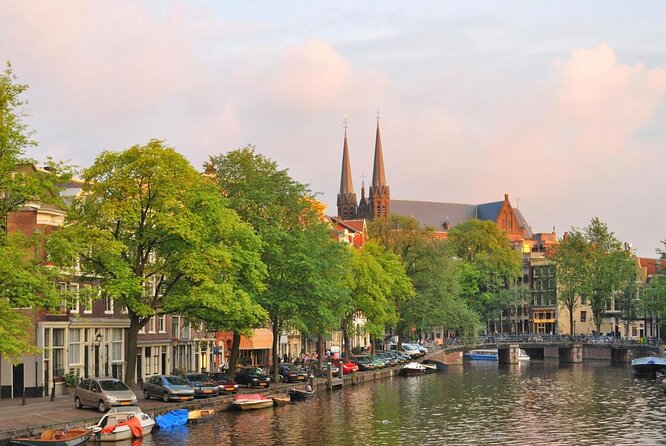
- Live skipper stories that connect landmarks to how Amsterdam grew
- Small-group feel with a maximum of 48 passengers
- Warm blankets provided for evening chill and winter nights
- Onboard bar (drinks for purchase; no snacks included)
- Big photo moments like Magere Brug and the Flower Market area
- Well-placed departure near Anne Frank House on Prinsengracht 263
Why this 1-hour Amsterdam evening cruise is such a smart move
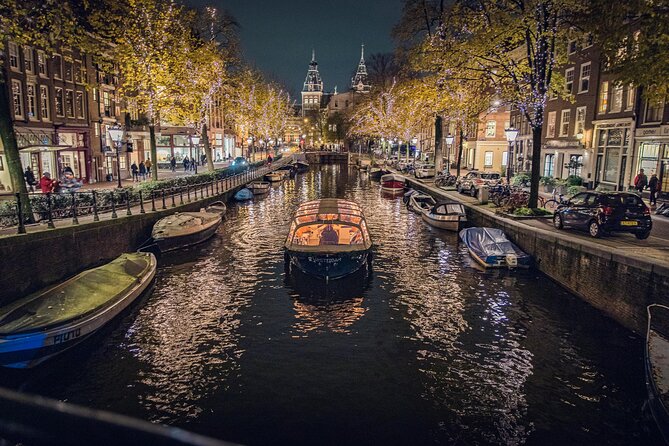
Amsterdam can be a lot on day one. Streets, bikes, canals, crowds, and you’re trying to remember where everything is. A canal cruise at night is a fast fix. In about an hour, you get a real sense of Amsterdam’s layout: how the canals wrap the city, where the bridges create shortcuts, and why neighborhoods feel distinct.
I also like that the guide focuses on what you’re actually seeing from the water, not on a distant lecture. You’ll pick up story cues that make later walking easier. For example, you’ll hear why the Jordaan name matters, how Amsterdam expanded from a dam on the Amstel, and what the canal ring is all about. It’s the kind of orientation that helps you stop guessing.
And yes, you’ll see the canal belt in evening light. The contrast is real. Even if you’ve seen photos already, watching the bridges and canal houses glide by gives you scale and depth that street views don’t.
You can also read our reviews of more boat tours in Amsterdam


The boat setup: comfort, blankets, and the onboard bar

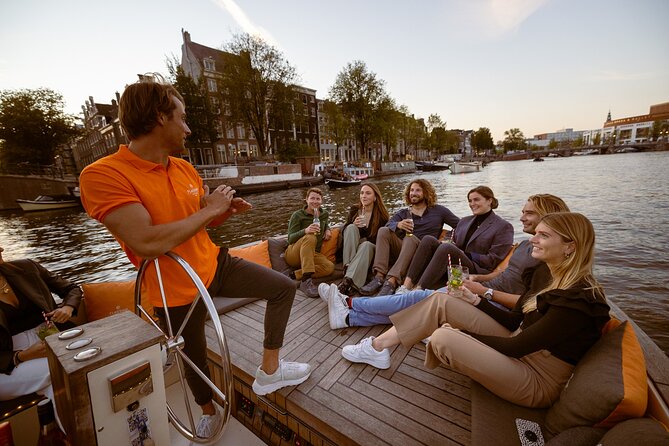
This cruise runs on a luxury-style boat with an experienced skipper and live guide, and the vibe is friendly. The group size is limited (up to 48), which matters. In bigger boats, you can end up drifting into background noise. Here, the guide tends to keep things interactive enough that you can actually follow the story.
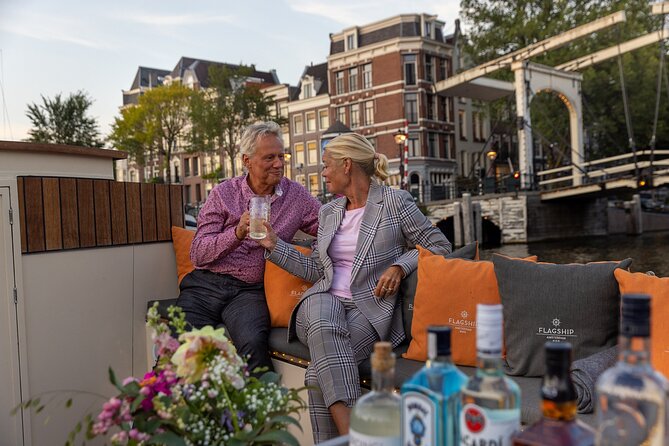
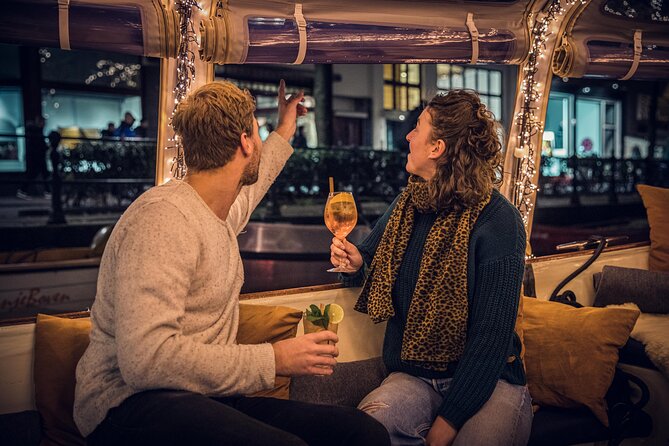
Comfort is part of the design. Warm blankets are provided, and that small detail changes the whole experience, especially in winter or when the wind finds you. If you’re the type who lasts 15 minutes outside and then wants a warm bench, this is the difference between enjoying the ride and wishing you’d chosen a cozy indoor activity.
There’s also an onboard bar. Drinks are available for purchase, which lets you set your own pace: water and hot drinks in spirit, or a beer/wine stop while you watch the lights. Just know what you’re signing up for: this is not a snack-and-drink included meal cruise. Snacks aren’t included either.
Where you meet: Prinsengracht 263 and the Jordaan start
Your cruise departs near the Anne Frank House, at Prinsengracht 263. That’s a very central “you can’t miss it” kind of area—until you realize lots of boats use the same general canal zone.
The tour description says it starts and ends in the Jordaan. Practically, that means you’re in the right neighborhood right away. The Jordaan is the kind of area where the canal streets feel intimate, with names and references you’ll keep hearing during the stories. The cruise uses that backdrop to set the tone: Amsterdam as a city of districts, not just canals.
My practical tip: arrive a little early and look for the specific boat/operator you booked. One bad experience I’ve seen described is what happens when the meeting instructions are confusing in a dock area full of operators. Save yourself stress by giving yourself extra time and verifying the boat name before you step onboard.
What you’ll see first: Jordaan origins and the Prinsengracht pulse
The ride opens with the Jordaan story—right at the level you’ll actually care about while gliding through canals. You’ll hear two theories about where the name comes from, including a connection to French Jardin (garden), plus the idea that canal and neighborhood naming could have been influenced by older nicknames around the Prinsengracht.
Then comes Prinsengracht itself, one of the main canals. The guide also points out the houseboat museum area along Prinsengracht, which helps you understand something important: Amsterdam’s “historic canal look” isn’t just decoration. It’s how people lived, worked, and built community along the water.
From there, you’ll pass through the region around the nine straatjes (the Nine Streets). This is a great “now I get it” segment. You might have heard of the shopping streets. From the canal, you understand how small the blocks feel and why people like wandering off the main routes to explore quietly.
The UNESCO canal-belt moment: Herengracht, Prinsengracht, Keizersgracht
The big idea of the canal belt—the Grachtengordel—is that three major canals were dug in the 17th century during the Dutch Golden Age. You’ll hear the names: Herengracht, Prinsengracht, and Keizersgracht, described as concentric belts around the city.
That matters because it changes how you read Amsterdam. Instead of treating canals like scenery, you start to see them as infrastructure that shaped wealth, housing, and street patterns. The guide also mentions the sheer number of monumental buildings along these waterways and that the 17th-century canal belt (including the Jordaan and the three main canals) is a UNESCO World Heritage Site since 2010.
You’ll get this sense without doing homework. From the boat you can watch the city’s “layers” unfold: where the biggest canals run, how the smaller waterways connect, and how bridges knit neighborhoods together. It’s also a strong photography segment if you can keep your windows clear and accept that some angles are easier than others.
You can also read our reviews of more evening experiences in Amsterdam


The bridge runs: Blauwbrug, Magere Brug, and why bridges matter here
Bridges in Amsterdam aren’t just crossings. They’re landmarks, meeting points, and views. The cruise includes a historic bridge called Blauwbrug (Blue bridge), crossing the Amstel. The guide explains it as a connector between areas like Rembrandtplein and Waterlooplein, which gives you a mental map you can use later when you’re walking.
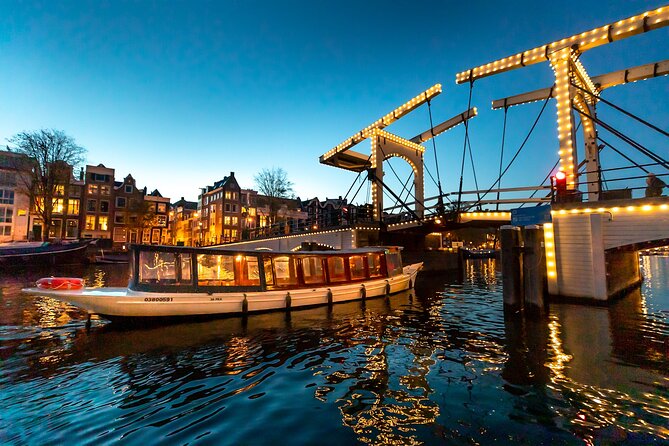
Then you’ll move toward one of the city’s most famous photos: Magere Brug, often nicknamed the Skinny Bridge in English. It’s known for being a wooden drawbridge once narrow enough that two pedestrians would struggle to pass. The cruise also points out the version that was later replaced to handle increased traffic (in 1871).
This is where night lighting shines. When the bridge draws or stands out against the water, you get a clean, iconic Amsterdam frame. And because this is an evening cruise, you’ll see the canal houses and bridges in a softer light, not under harsh midday glare.
Singel and the medieval city wall idea
One of the less obvious parts of Amsterdam is how far back the water defenses go. The Singel canal is described as having encircled the city in the Middle Ages and functioning as a moat until 1585, when Amsterdam expanded beyond it.
Hearing that from the boat is useful. It gives the city a timeline. When you see the canal ring shapes, you start to understand that “curves and water lines” reflect older walls and old boundaries, not just convenient waterways for views.
The Singel is described as running from the IJ bay near Central Station to Muntplein square, where it meets the Amstel. Even if you don’t memorize every coordinate, you’ll remember the idea: this is the inner-most canal ring shape, and it reflects an earlier Amsterdam “contained city” mindset.
Munttoren and money-making history you can actually picture
The Munttoren (Mint Tower) shows up in the story as part of the medieval city wall, connected to gates like Regulierspoort. You’ll hear it was built between 1480 and 1487, and that in the 17th century it was used to mint coins.
Why I like this stop-by-passing moment: it makes the Golden Age more concrete. When guides only talk about art and wealth in vague terms, it can feel abstract. A mint tower is specific. It tells you this wasn’t only about merchants getting richer—it was about systems, production, and government power built into the city.
Flower Market from the water: the only floating market idea
The Amsterdam Flower Market is a standout: described as the only floating flower market in the world, and it exists since 1862. You’ll pass it by boat, seeing the stalls stand on houseboats.
This is one of those details that changes your expectations for the city’s “seasonal” reputation. Flowers here aren’t only summer vibes. The cruise narrative frames it as fragrant and interesting in all seasons, which is exactly the kind of fact you’ll appreciate if you’re traveling in off months.
And it’s a fun contrast to the canal history. One minute you’re hearing about city defenses and Golden Age canals, the next you’re watching a living market line up along the water.
Canal-house life: Grachtenhuis and the museum-style story vibe
The cruise route also lines up with museum-style canal history, including the Grachtenhuis on Herengracht. This museum is dedicated to the 17th-century Amsterdam canals and uses interactive and multimedia exhibits to tell the history of the canal belt.
Even though you’re not going inside on this cruise, you’re getting a “pre-lecture” version of what the museum covers. You’re shown the canal belt idea while the name is fresh. That helps if you’re the type who likes to connect outdoor sightseeing with a later indoor visit.
You also pass by the Willet-Holthuysen Museum area along Herengracht (Willet-Holthuysen Museum on Herengracht 605). It’s a canal house with fully furnished period rooms open to the public. Again, you won’t tour it during the cruise, but the stories help you understand why these houses mattered: they’re physical proof of how people displayed wealth and lived in canal-side spaces.
Amstel and Amsterdam’s founding story: dam to city
Every good Amsterdam canal story points back to the Amstel. The cruise describes the Amstel as the biggest canal of all and connects Amsterdam’s founding to the Amstel river, which was originally a river. It also includes the famous origin idea: fishermen building a dam and calling the resulting settlement Amsterdam.
You’ll notice that the guide’s storytelling keeps coming back to water as the reason the city exists in the first place. That’s why the narration feels more satisfying than random facts. It ties the bridges and canal rings into a cause-and-effect pattern: water shaped trade, trade shaped wealth, wealth shaped the canal build-out.
If you want one “why Amsterdam looks like this” takeaway, this is it.
Photo and window reality: what to do when it’s cold
One of the most repeated practical issues I’ve seen on this type of night cruise is window fog. If your seat is near glass, temperatures inside and outside can turn windows into a blurry sheet. That makes it harder to take sharp photos.
If you want the best chance at clear pictures:
- Choose a position where you can lean or shoot without pressing fully into the window.
- Bring a phone lens cloth if you have one. Even a quick wipe helps.
- Accept that some shots will be better from angles over the railing than through glass.
Blankets help you stay put and comfortable, which indirectly helps your photos. If you’re warm, you don’t bounce around trying to get better sightlines every minute.
Also, it’s an evening cruise in an outdoor-or-open feeling world depending on the boat setup. Even if you’re not directly told it’s open, you’ll likely feel the night air at some point. Plan for chill.
Price and value: why $27.57 can be a good deal
At $27.57 per person for about an hour, this sits in the mid-range for Amsterdam canal cruises. The value comes from what’s included: an experienced skipper and a live guide, a luxury-style boat, warm blankets, and a small-group experience with a maximum of 48 people.
The bar is extra by purchase, and snacks and drinks aren’t included. That’s normal for many canal cruises. If you plan to buy alcohol, factor that in when comparing prices to other operators. But even without drinks, you’re paying for guided interpretation during prime evening time, when Amsterdam is at its most atmospheric.
One other value point: the itinerary covers multiple big “Amsterdam tells” in a short loop—Jordaan, UNESCO canal belt concepts, major bridges like Magere Brug, and the Flower Market zone. You’re not just floating near one highlight. You’re getting a city-wide orientation.
Who this evening cruise fits best
This is a strong pick if:
- It’s your first night and you want fast orientation
- You like live commentary rather than silent sightseeing
- You travel in cooler months and want built-in warmth
- You want a manageable 1-hour activity that doesn’t crush your evening
It’s less ideal if you:
- Need guaranteed perfect window views for photos (fog can be an issue)
- Want a stop-and-get-out tour (this is a cruise, not a museum hopping plan)
- Hate the idea of a dock area that can feel confusing in a busy canal zone (arrive early and confirm your specific boat)
Should you book this 1-hour Amsterdam canal cruise?
If you want an easy, evening-friendly introduction to Amsterdam’s canal layout and history, I think this is a smart booking. The combination of live skipper storytelling, small-group vibe, and warm blankets makes it feel worth the time—especially when everything else in the city is starting to feel like a long line or a crowded street.
Book it if you value guidance and comfort more than you value getting out to explore on foot. Don’t overthink it, but do one thing well: arrive early enough to find the correct dock near Prinsengracht 263 and confirm you’re on the right boat name for your operator. That one step can turn this into a smooth, satisfying hour instead of a stressful scramble.
FAQ
How long is the Amsterdam evening canal cruise?
It’s about 1 hour.
Is the tour offered in English?
Yes, it’s offered in English.
What’s included in the price?
You get an experienced skipper and live guide, the luxury boat experience, warm blankets, and the onboard bar is available for purchase.
Are snacks or drinks included?
No. Snacks aren’t included, and drinks are available for purchase on board.
Where does the cruise depart?
The cruise departs near the Anne Frank House at Prinsengracht 263.
How large is the group?
The maximum group size is 48 travelers.
What happens if the weather is bad?
If it’s canceled due to poor weather, you’ll be offered a different date or a full refund.
Are warm blankets provided during the cruise?
Yes, warm blankets are provided for those who need them.