REVIEW · AMSTERDAM
Amsterdam: Historic City Sightseeing Canal Cruise
Book on Viator →Operated by Amsterdam Circle Line · Bookable on Viator
One hour, and Amsterdam starts making sense. This historic canal cruise gives you the big-picture view of Amsterdam’s UNESCO-listed canals, with a super convenient start just outside the Anne Frank House.
I especially like the easy meeting point in front of the Anne Frank museum, plus the fact that you see a serious mix of city icons without spending hours walking. One thing to consider: the narration is delivered through a voice-over system, and a few people found it hard to hear clearly (especially if you sit near the back), so aim for a spot where you can catch the audio.
In This Review
- Key highlights at a glance
- Starting at the Anne Frank House: a practical Amsterdam “day-one” win
- Cruising the UNESCO Canal Ring from the water
- Museum of the Canals: setting your 400-year lens
- Anne Frank House from the canal side: why it hits differently
- Westerkerk and Calvinist architecture: spotting a key church on Prinsengracht
- Houseboat Museum and the Hendrika Maria: a cozy history lesson on water
- Canal details that make you slow down: Leidsegracht and De Beulingsloot
- Bartolotti House: reading wealth in a 1600s canal façade
- Melkmeisjesbrug: the milk market bridge with centuries behind it
- Brouwersgracht and the Jordaan edge: Amsterdam’s “most beautiful street” claim
- The canal-belt church turned concert hall: where architecture changes jobs
- Amsterdam Centraal, the IJ, and EYE: modern edges after the canal belt
- Posthoornkerk: a church with a two-phase build and an extra-high interior
- Downriver to the Amstel and Hermitage Amsterdam
- Stopera: city hall and national opera in one landmark
- Price and value: is $18.71 a smart deal for 1 hour?
- What to watch for: audio clarity and the best seats
- Who this canal cruise suits best (and who should rethink)
- Should you book this Amsterdam canal cruise?
- FAQ
- How long is the Amsterdam historic city sightseeing canal cruise?
- Where is the meeting point?
- What language is the tour offered in?
- Do I get a mobile ticket?
- How big is the group on this cruise?
- Is free cancellation available?
Key highlights at a glance
- Meet by the Anne Frank House for quick, central orientation on day one
- UNESCO Canal Ring views from the water, with churches, opera, and canal houses
- A tight 1-hour cruise that works even when your Amsterdam schedule is packed
- Houseboat Museum experience via the Hendrika Maria, a 1914 former cargo ship
- Lots of variety on one route: old canal belt, then IJ waterfront, then the Amstel
- Small-ish group feel with a max of 68 people, plus the option to stay inside or out
Starting at the Anne Frank House: a practical Amsterdam “day-one” win
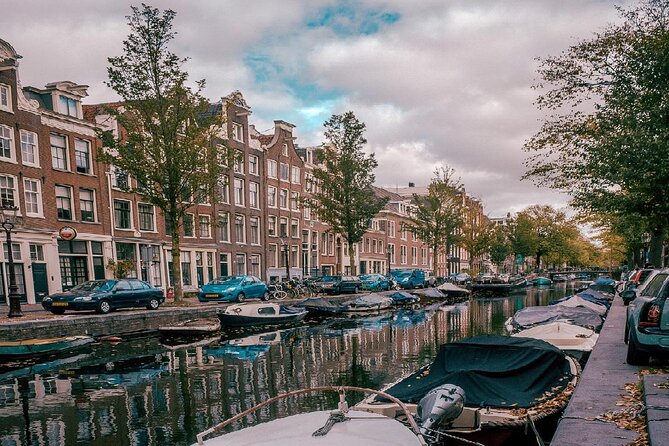
If you want an efficient first look at Amsterdam, this is a strong setup. The meeting point is right by the Anne Frank House, so you can line it up with a museum visit you were already planning. That matters in Amsterdam, where navigation is easy but time gets eaten by transit, queues, and detours.
From there, you get moving fast. You’re not stuck in a long intro or bus transfer. You’re out on the water, and suddenly the canal geometry that looks confusing from the street starts feeling logical. Plus, the location is central enough that you can easily pair this with walking later—Jordaan streets, museum areas, and canal-house neighborhoods.
You can also read our reviews of more boat tours in Amsterdam


Cruising the UNESCO Canal Ring from the water
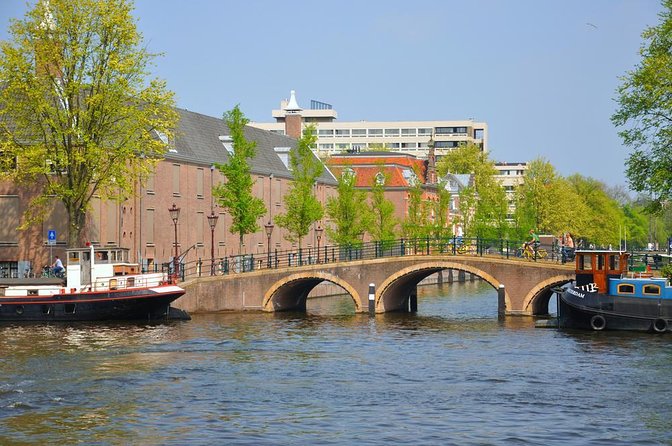
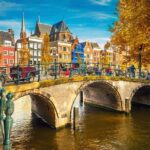
The main idea here is simple: Amsterdam’s canals are where the city’s identity lives, so it’s worth seeing them from the same height as the buildings. From the boat, you get a cleaner line of sight at the architecture, the canal bridges, and the way the canal belt threads neighborhoods together.
You’ll float past landmark clusters that most people only study on photos or postcards. Expect churches, ornate canal houses, and major cultural buildings. This is also one of the best ways to understand why the UNESCO Canal Ring is such a big deal: the canal network isn’t just scenery. It’s the framework for how Amsterdam grew, where people lived, and how the city moved.
And since the cruise is about one hour, it’s a low-commitment way to get oriented before you decide where to spend your extra energy on foot.
Museum of the Canals: setting your 400-year lens
The cruise starts with a step back in time at the Museum of the Canals. You’re not getting a long lecture here, but you are getting the right context: Amsterdam didn’t become Amsterdam overnight. The canal system is part engineering, part design, and part social map.
This early framing helps once the boat starts passing the older canal-belt buildings and bridges. Without that context, you might just admire pretty facades. With it, you start noticing how the city’s waterways connect the past to the present—where commerce mattered, where communities clustered, and how the waterfront shaped daily life.
Anne Frank House from the canal side: why it hits differently
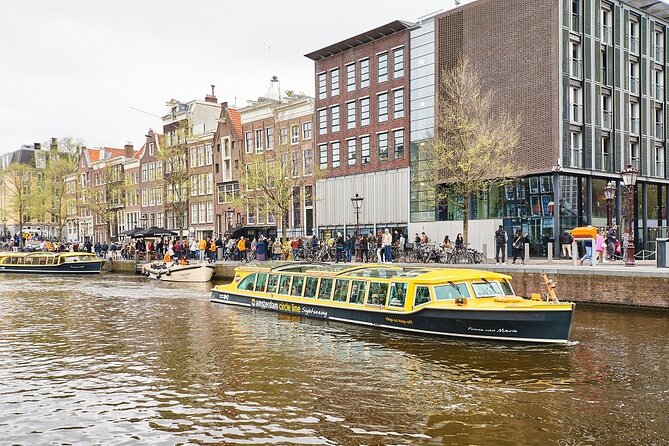
It makes sense this cruise includes the Anne Frank House. The building sits on the Prinsengracht, and seeing it from the water gives it a different weight than a street-level approach.
The Anne Frank House is a writer’s home and biographical museum dedicated to Anne Frank. During World War II, Anne Frank and her family hid from Nazi persecution in the Secret Annex at the rear of the 17th-century canal house. Her diary was published in 1947, and the Anne Frank Foundation was later set up to protect the property from redevelopment pressures.
Here’s the key for you: this stop is emotionally heavy, so it’s worth planning your pace. Don’t rush past it on autopilot. Take the moment to notice the canal setting around the building—Amsterdam’s calm water scene is exactly what makes the history so jarring.
Westerkerk and Calvinist architecture: spotting a key church on Prinsengracht
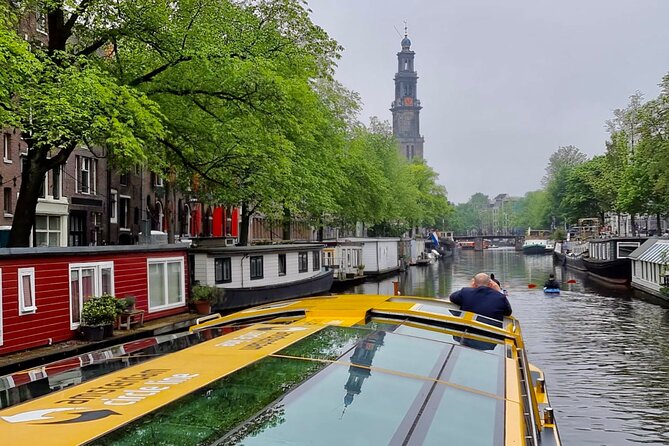
Next you pass the Westerkerk. It’s a Reformed church within Dutch Protestant Calvinism in central Amsterdam, located between the Prinsengracht and Keizersgracht, next to the Jordaan area.
From the boat, you get a better sense of how these monumental churches functioned as community anchors. They weren’t just religious buildings; they were landmarks. That’s why you’ll often hear people talk about Amsterdam’s “city silhouette.” Canal travel makes that silhouette easier to read, because you’re moving along the same lines as the canal belt.
If churches aren’t usually your thing, this one can still work because you’re not just looking at stone—you’re seeing how the building relates to the surrounding canal streets.
You can also read our reviews of more city tours in Amsterdam
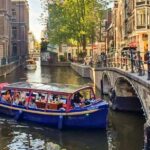
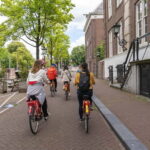


Houseboat Museum and the Hendrika Maria: a cozy history lesson on water
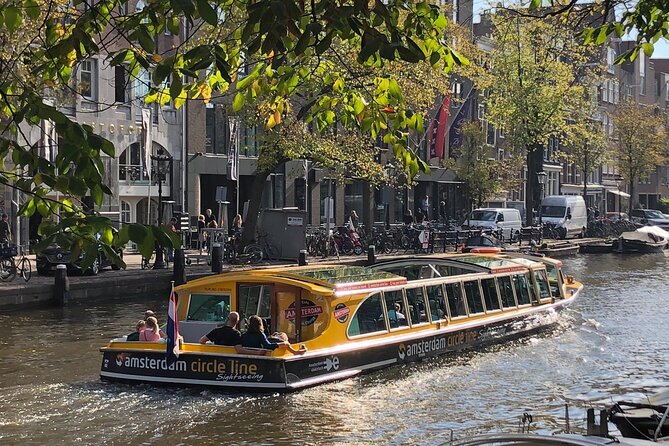
One of the most distinctive parts of the route is the Houseboat Museum experience. You get a first-hand feel for what houseboat living is like in Amsterdam, and the museum is in a vessel called the Hendrika Maria, a former cargo ship built in 1914.
Here’s the practical payoff: a cargo ship cargo hold being turned into a comfortable living space tells you a lot about Amsterdam’s relationship with water. People didn’t always treat canals as decoration. They treated them as infrastructure, shelter, storage, and daily reality. And yes, it’s surprising how much space and comfort can exist in that kind of repurposed space.
Even if you never plan to live on a boat, this is a great reality check. The canal world here isn’t only about old-timey views—it’s also about how people actually live.
Canal details that make you slow down: Leidsegracht and De Beulingsloot
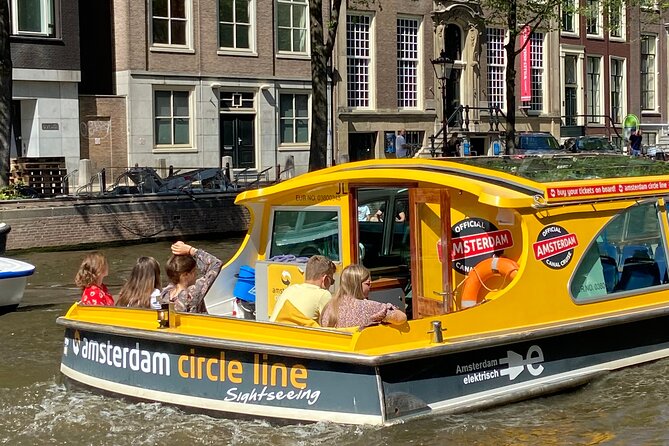
As the cruise continues, you’ll glide past canals that help explain Amsterdam’s canal structure.
Leidsegracht is a cross-canal that links several major canal arteries: Herengracht, Keizersgracht, Prinsengracht, and Lijnbaansgracht. It then flows into the Singelgracht. From the boat, you can understand how Amsterdam’s canal belt works like a connected system rather than disconnected canals.
Then there’s De Beulingsloot, described as one of the oldest and shortest canals in the center. That combo—old + small—makes it a fun contrast point. Big canals can feel like main highways; a short canal feels like a narrow local street. Seeing both helps you read the city at multiple scales.
Bartolotti House: reading wealth in a 1600s canal façade
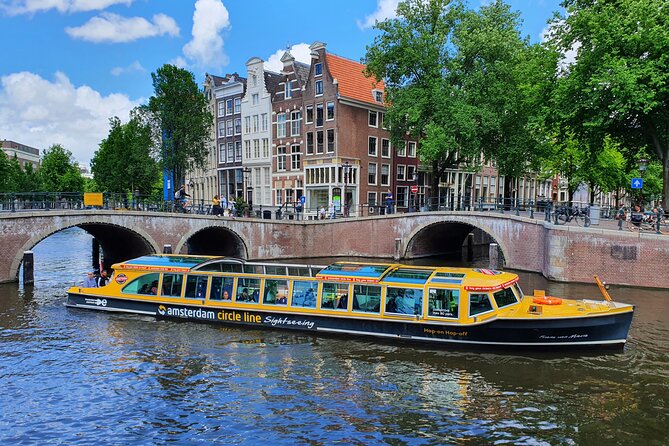
Another memorable pass is the Bartolotti House on Herengracht 170-172. It was built around 1617 for Willem van den Heuvel tot Beichlingen, one of the richest Amsterdammers at the time, who inherited money from a childless uncle by marriage to Giovanni Battista Bartolotti, a merchant from Bologna.
Why this matters on a boat: the canal house frontage is basically a visual resume. From street level, it’s easy to miss how much power these buildings communicated. From the water, you can see the full relationship between façade, canal width, and bridge lines.
If you enjoy architectural storytelling, you’ll probably find yourself thinking: okay, this isn’t just pretty. This is social status in brick and stone.
Melkmeisjesbrug: the milk market bridge with centuries behind it
Melkmeisjesbrug is a fixed bridge in Amsterdam-Center where there has been a bridge for centuries. The bridge appears on maps signed by people like Balthasar Florisz. van Berckenrode (1625), Joan Blaeu (1649), and Daniël Stalpaert (1662).
The modern era changes start in 1883, when a pedestrian drawbridge was replaced by a permanent bridge. Later, because passage was too narrow, abutments and the bridge were renewed in 1903 with a paraboolligger design using iron sickle girders. A steel version followed in 1966.
It’s named after the milk market that used to be held there, and a milkmaid image served as a sign for a later catering establishment. The bridge is also probably the place where the first type of Amsterdammertje was placed.
Translation for you: this is one of those sights that’s easy to overlook until you know what to look for. A bridge isn’t just a crossing here. It’s a pointer to old markets, trade patterns, and everyday city life.
Brouwersgracht and the Jordaan edge: Amsterdam’s “most beautiful street” claim
Brouwersgracht runs from the Singel to the Singelgracht and forms the northwestern border of the Grachtengordel. Between the Prinsengracht and the Singelgracht, it marks the northern border of the Jordaan.
It also has a specific local claim to fame: in 2007, Brouwersgracht was voted the most beautiful street in Amsterdam by readers of Het Parool, chosen from 150 nominations.
For your cruise experience, this stop helps you see how Amsterdam’s neighborhoods were shaped by waterways. The boat doesn’t just show buildings; it shows boundaries and transitions. That makes it much easier to plan where you’ll want to walk after you get off.
The canal-belt church turned concert hall: where architecture changes jobs
Another important pass is a church designed by Adriaan Dortsman, opened in 1671. It was nearly destroyed in 1822 and rebuilt in 1826. The organ was built by J Batz in 1830 and restored in 1983 by Flentrop Orgelbouw.
Later, in 1935 the Lutherans left, and it became a concert hall. In 1975 a tunnel was built by the neighboring Sonesta Hotel—today called the Renaissance Amsterdam Hotel—for access. The hotel rents the church from the Lutheran church, which remains the owner. The church closed for restoration in 1983, and in 1993 the dome caught fire. It was restored again after that.
This is a good reminder that buildings in Amsterdam don’t always stay in one role. Water cities evolve. If you notice the architectural style shifts, you’re likely seeing the city adapt—just like you will.
Amsterdam Centraal, the IJ, and EYE: modern edges after the canal belt
After the older canal belt, the route swings into Amsterdam’s modern waterfront mood.
You’ll pass Amsterdam Centraal, designed by Pierre Cuypers, who’s also known for the Rijksmuseum. Cuypers was principal architect, and it’s believed he focused mostly on the station building’s decoration, while structural work was handled by railway engineers.
Then you move along the IJ, a body of water known for being Amsterdam’s waterfront. This part of the ride is useful because it gives you a breath from the dense canal-house look. You can see the city’s scale from a wider angle.
EYE Filmmuseum is another highlight: the building was designed by Delugan Meissl Associated Architects, and it includes multiple cinema spaces (including a 300-seat cinema and several smaller ones). Even if you’re not a film museum person, it’s a strong modern landmark to anchor your mental map.
Posthoornkerk: a church with a two-phase build and an extra-high interior
The Posthoornkerk is designed by P.J.H. Cuypers and dates from 1860. It replaced a hidden church called De Posthoorn on the Prinsengracht, and the name was carried over.
The church was built in two phases: the choir, transept, crossing tower, and nave were built between 1860 and 1863. The two-tower front was added later, from 1887 to 1889. Because the church couldn’t be built free-standing, it was made extra high. Galleries were added above the side aisles to use limited space. The exterior is neo-Gothic, while the late Romanesque Munsterkerk in Roermond served as an interior model.
On a cruise, this is great because you can actually take in the vertical effect. If you’ve ever looked at churches on foot and felt like the building never fully shows itself, the boat perspective helps. You see the proportions without needing a big square or street canyon.
Downriver to the Amstel and Hermitage Amsterdam
The cruise also includes the Amstel, the river that flows into the IJ. It’s tied to major events like Liberation Day concert moments, the Head of the River Amstel rowing match, and an Amsterdam Gay Pride boat parade.
Historically, the Amstel formed around 1050 BC when a freshwater river cut into a tidal channel of the IJ (around what are now Damrak and Rokin). That’s a big detail, and it helps you remember that Amsterdam’s waterways are ancient, not just decorative.
Along the Amstel you’ll pass Hermitage Amsterdam, a satellite museum connected to the Hermitage Museum of Saint Petersburg. It’s located on the banks of the Amstel in a classical style building called the Amstelhof from 1681.
The complex includes the former Amstelhof space, and it also ties to an adjacent Neerlandia Building that supported smaller exhibitions before the main museum opened. The museum’s size is significant: total area 12,846 m2, with 2,172 m2 dedicated to exhibition space. The rest includes lecture halls, offices, staff accommodations, and a restaurant.
If you like museums but don’t want to commit to a full museum day, this pass gives you a readable preview. You can decide later whether it deserves your walking time.
Stopera: city hall and national opera in one landmark
Finally, you’ll see the Stopera complex, which houses the city hall of Amsterdam and the Dutch National Opera and Ballet. It’s home to the Dutch National Opera, Dutch National Ballet, and Holland Symfonia.
The building was designed by Wilhelm Holzbauer and Cees Dam. The name Stopera comes from a protest slogan, Stop the Opera, not from a portmanteau of city hall and opera. The opera and ballet organization is also noted as never using the name in their communication.
From the boat, this kind of landmark works well because it breaks the cruise rhythm. You go from canal-belt architecture to a major civic and cultural building that signals how Amsterdam wants to be seen today.
Price and value: is $18.71 a smart deal for 1 hour?
At $18.71 per person for about an hour on the water, this cruise is priced like an efficient sampler. You’re paying for perspective, not for deep museum entry. In a city where the most popular sights can eat time, this feels like a practical trade: you buy one short experience and get a route that touches a lot of famous context.
A few value points you can actually use:
- It’s central (start near Anne Frank House), so your time isn’t wasted on far-flung transit.
- It’s short enough that it works on arrival day or departure day.
- The route includes both older canal-belt sights and modern waterfront hits, so you don’t feel locked into one style of Amsterdam.
If you’re the type who hates spending hours just to get oriented, this is a good fit.
What to watch for: audio clarity and the best seats
This is where you should set expectations. Some people loved the guide or captain’s humor and delivery, but others said they had trouble hearing the commentary. A few also mentioned the language switching didn’t always feel smooth, and that the audio can be hard to catch from certain seating positions.
One review-specific detail that matters: rear seats at the back of the boat can be great for unobstructed views, but narration may not be audible there. So if your priority is hearing the facts, I’d prioritize sound over maximum back-window views.
Cold or windy days are also worth planning for. The good news is you can usually pick inside or outside depending on comfort, and the cruise can still be enjoyable even when the weather is not cooperating.
Who this canal cruise suits best (and who should rethink)
This tour fits best if you want:
- A time-efficient way to see lots of Amsterdam highlights from one ride
- A strong starting point near a must-do museum area
- Scenic views paired with on-the-water context for the canal belt
You might want a different option if you’re very sensitive to audio quality. If you know you’ll be bothered by unclear narration, or if you’re expecting constant, loud live commentary, the recorded voice-over format can feel frustrating.
Also consider timing. On at least one occasion, departures were impacted by a Pride Parade happening in the canal. If you’re visiting during major canal events, give yourself extra flexibility.
Should you book this Amsterdam canal cruise?
Yes, if you want a simple, efficient way to connect the big landmarks: UNESCO canal-ring scenes, Anne Frank House area context, and then a shift to the IJ and Amstel highlights. For the price and the short duration, it’s a solid value for first-timers and for anyone who only has a day or two.
I’d only hesitate if your main goal is highly detailed, perfectly audible, live-level storytelling. In that case, bring ear comfort in mind and plan your seating so you can actually catch what’s being said.
FAQ
How long is the Amsterdam historic city sightseeing canal cruise?
It runs for about 1 hour.
Where is the meeting point?
The meeting point is in front of the Anne Frank House.
What language is the tour offered in?
The experience is offered in English.
Do I get a mobile ticket?
Yes, the tour includes a mobile ticket.
How big is the group on this cruise?
The maximum group size is 68 travelers.
Is free cancellation available?
Yes. You can cancel for a full refund up to 24 hours in advance.