REVIEW · AMSTERDAM
Amsterdam in World War Two Cycle Tour
Book on Viator →Operated by Slagveldreizen.nl · Bookable on Viator
Cycling through Amsterdam during WWII is haunting. This small-group ride ties street corners to real events, and wartime photos matched to what you see today make the past feel shockingly close.
One big plus is the format: you cover real neighborhoods by bike instead of shuffling through the same few blocks on foot.
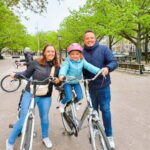
I also love the tight group size and the way guides Rudy and Peter keep things moving, safe, and understandable. You get to ask questions, and the tour stays focused because it’s built for just up to six riders.
The only drawback is the subject matter. You’ll spend hours on arrests, deportations, and executions—so it’s best if you’re ready for heavy WWII stories and you’re comfortable cycling for about 2.5 to 3 hours.
In This Review
- Key highlights that make this tour worth your time
- Why this Amsterdam WWII bike tour feels different than museums
- Meeting at Tesselschadestraat and getting the rhythm right
- Victorieplein to Olympiaplein: following the June 20, 1943 raid
- Merwedeplein and Waalstraat: the Frank family, a diary, and Tilex Bar
- Museumplein’s stronghold: consulate offices, NSB HQ, bunkers, and Flak
- Roelof Hartplein coffee stop and the resistance photo shop
- Beethovenstraat to Apollolaan: executions and retaliation in late 1944
- Rubensstraat and Memlingstraat: SD-HQ, stolen possessions, and RAF strikes
- Olympiaplein to Parnassusweg, then Amsterdam Lyceum: registration to Luftwaffe HQ
- Queen Emma’s statue and the final day after May 7, 1945
- Price and value: what $66.09 buys you in real terms
- Who this tour suits best (and who should think twice)
- Should you book it?
- FAQ
- How long is the Amsterdam in World War Two cycle tour?
- Where is the meeting point?
- What time does the tour start?
- Is the tour offered in English?
- What’s the group size limit?
- Do I get a ticket on my phone?
- Does the route focus on a specific part of Amsterdam?
- Is there a break for coffee or restrooms?
- Who runs the tour?
- What is the cancellation policy?
- How far in advance is it usually booked?
Key highlights that make this tour worth your time
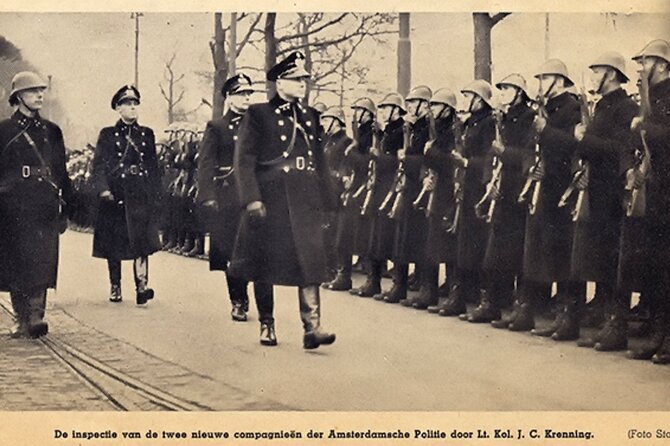
- WWII-before-and-after photos at real locations: see how the street looked during the occupation.
- Car-bypassing bike access in Amsterdam South: reach areas cars can’t easily reach.
- Small group with strong guide storytelling: max six riders, with Rudy and Peter leading.
- Frank family stops without museum crowds: Merwedeplein and the surrounding Waalstraat area matter deeply.
- A moving walk through the German “machine” of control: SD/Gestapo offices, registration points, and resistance actions.
- Practical pacing with one coffee and restroom break: a short stop around Roelof Hartplein.
Why this Amsterdam WWII bike tour feels different than museums
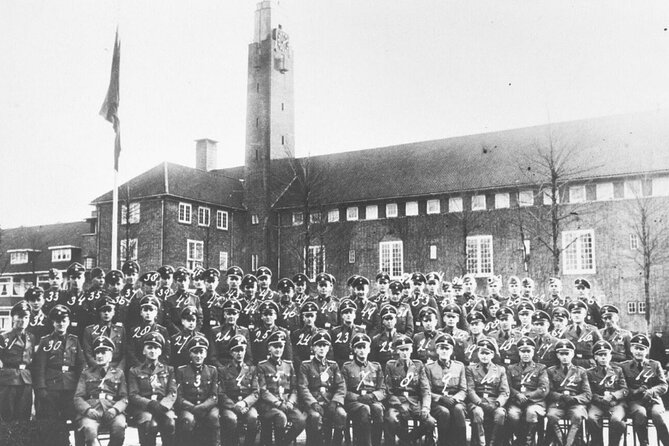
WWII in Amsterdam can feel like a set of dates and names until you stand in the right place and see how normal everything looks now. This tour uses the city like a living map. You ride between sites tied to arrests, forced registration, resistance strikes, and the final tense days after liberation—then you get wartime photos that line up with the modern street view.
That visual match is what makes it work. It’s one thing to read about what happened; it’s another to line up a 1940s scene with the building in front of you and realize how much went on in plain sight. It also helps that the route sits in south Amsterdam. That means you’re not stuck in the tightest tourist bottlenecks the whole time.
The bike format is more than convenience. Cycling lets you cover more ground than walking, but without the bus-full feeling. It also helps the tour stay coherent: you’re moving from one chapter to the next, so the story doesn’t stall between stops.
You can also read our reviews of more cycling tours in Amsterdam
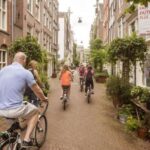
Meeting at Tesselschadestraat and getting the rhythm right
The tour starts at Tesselschadestraat 1, 1054 ET Amsterdam, with a 11:00 am start. It ends back at the meeting point, and you’ll be guided through Vondelpark toward Leidseplein to wrap up.
What you should expect from the start: clear navigation and a pace that keeps the group together. The experience is designed for safety on the bike—one reason people come back praising how secure it feels. With a maximum of six travelers, the guide can slow down when questions pop up and still keep you on schedule.
You’ll also have a mobile ticket, so you’re not juggling paper. And because the tour is offered in English, you won’t lose the thread when the story gets detailed (and it does).
Victorieplein to Olympiaplein: following the June 20, 1943 raid
Early on, the tour sets a stark tone at Victorieplein—then called Daniël Willinkplein. On June 20, 1943, a major raid hit Amsterdam. At the foot of the skyscraper, large groups of Jewish residents were arrested during what was labeled the Judenaktion.
Here’s a detail I think matters for understanding the system: the arrests weren’t carried out only by Germans. Dutch police units, known as PBA (Police Battalion Amsterdam), and police volunteers tied to the NSB (Dutch National Socialist Movement) assisted in the process. That collaboration point often gets glossed over in big-picture summaries, but standing at the site makes it harder to forget.
From there, the tour traces what happened next. Jews were transported to Olympiaplein, including for registration, and then onward to the Westerbork concentration camp in the east of the Netherlands. This stop helps you see how control worked step-by-step—raid, transport, registration, then deportation.
If you’re sensitive to distressing history, I’d treat this segment as the tour’s emotional opening act. It’s not graphic, but it’s blunt. The payoff is that you’re not just hearing about victims; you’re seeing the logistics of oppression mapped onto real Amsterdam streets.
Merwedeplein and Waalstraat: the Frank family, a diary, and Tilex Bar
Next comes a place most visitors know only from history books, but here it’s rooted in the surrounding streets. The tour highlights Merwedeplein 37-II—the home of the Frank family.
You also get a statue commemorating Anne Frank on Merwedeplein. And the guide connects the family’s story to the neighborhood around Prinsengracht and the Secret Annex, including Otto Frank’s company and how the group ended up in hiding in Het Achterhuis.
One of the most moving parts is how the tour treats the diary not as a distant artifact, but as something purchased locally. Around the corner on Waalstraat, the guide points out Jimmink (still active) and explains how it sold the first edition of Het Achterhuis. The timeline is clear: the diary was published in 1947, and Otto Frank bought it for his daughter at that shop. This turns a famous document into a tangible Amsterdam moment.
Right across from Merwedeplein, at Waalstraat 48—now Café Blek—you learn about the former Tilex Bar, associated with Tilly and Lex van Weren. The tragic detail is harrowing: Lex van Weren survived Auschwitz because he was forced to play his trumpet at executions. That fact makes the bar scene feel impossibly close to the machinery of brutality. It’s a reminder that occupied cities didn’t just hide people—they also created situations where people were coerced into serving the system.
This pair of stops is strong because it balances three different lenses at once:
- family life and hiding,
- the book’s publication and how it lived in normal streets,
- and the moral violence inflicted even in everyday businesses.
Museumplein’s stronghold: consulate offices, NSB HQ, bunkers, and Flak
The tour then shifts to Museumplein, and the story changes from arrests to infrastructure. During the war, the Germans transformed Museumplein into a stronghold.
When you face the concert hall, the houses on the left were occupied by German offices. One example the guide calls out: the United States consulate building once housed the Zentralstelle für Jüdische Auswanderung—the Central Jewish Emigration Office. You also hear about neighboring buildings serving roles like the Ortskommandantur (Town Major) and the Feldgendarmerie (Military Police).
In front of these buildings sat the IJsclubterrein (Amsterdam skating club). And on this open area, the Germans built the stronghold with bunkers and anti-aircraft (Flak) batteries.
Then you learn about the political layer: the tour notes the NSB HQ Amsterdam next to the concert hall. After WWII, the bunkers were blown up—so you’re walking where military infrastructure once dominated the space.
I like this stop because it helps you understand that power wasn’t only carried out in back alleys. It was administrated and enforced using offices, police functions, and military equipment placed right in the middle of the city.



Roelof Hartplein coffee stop and the resistance photo shop
After the heavier segments, you get a brief reset at Roelof Hartplein. There’s a short stop at Café Wildschut for coffee and a restroom visit, about 10 minutes, with admission ticket free for that break.
This part isn’t just about comfort. It also gives you time to absorb what you’ve heard. WWII details stack quickly on a bike tour because you’re actively seeing the city and receiving context at each stop.
Then you move to Roelof Hartstraat, where the guide explains there was a photo shop next to the library building. During the war, the Dutch resistance used the store and developed unique photos—connected to the first roundup of Jews in Amsterdam by the SD/Gestapo and German police.
Near this area, there’s also a small monument remembering Jews taken from the neighborhood. It’s a quieter kind of remembrance than big memorial sites, and that makes it easy to miss if you’re not looking for it. The bike tour helps you notice it.
Beethovenstraat to Apollolaan: executions and retaliation in late 1944
At the corner of Beethovenstraat / Apollolaan, the story becomes personal and immediate. In late October 1944, around the front of no: 6, SS officer Herbert Oelschlägel—a Sicherheitsdienst / Gestapo agent—was executed by a Dutch resistance member.
In retaliation, the SD/Gestapo burned down two houses and executed 29 resistance fighters. The guide also notes that at the time, this street was called Euterpestraat, and that Gerrit van der Veen led an important resistance group.
This stop is where you feel the danger of resistance work and how quickly the occupiers struck back. It also shows why the tour’s format works: cycling between sites keeps the cause-and-effect chain moving. One action is met by another response, and you’re seeing that pattern in real places.
Rubensstraat and Memlingstraat: SD-HQ, stolen possessions, and RAF strikes
Two corners later, the tour tackles one of the most intense parts of the occupation system: the offices where oppression and theft were organized.
At Memlingstraat / Rubensstraat, you learn about two major Nazi oppression organizations:
- SD-HQ Amsterdam, described as SD Aussenstelle under Willy Lages.
- Hausraterfassungsstelle, focused on stealing the possessions of deported Jews, linked to the Zentralstelle für Jüdische Auswanderung.
The leader of the Hausraterfassungsstelle is named as Henneicke, a Dutch collaborator. You then get a clear example of how resistance tried to disrupt that machine: in November 1944, they asked the Royal Air Force through a secret radio message to attack the SD/Gestapo HQ and the Hausraterfassungsstelle. Destroying files was a key goal.
The attack is tied to Group Captain Denys Gillam DSO, DFC, AFC, leader of 149 (Typhoon) wing. That’s a lot of detail, but it lands because you’re standing near where the institutions sat.
The tour also references a safehouse at the corner of Rubensstraat / Gerrit van der Veenstraat, and you’re pointed toward a Stolperstein (stumbling stone) for the address. You also hear about betrayal: in June 1944, an address was reportedly betrayed to the SD/Gestapo by a female informant, referred to as V-Frau.
This is the stop that gives you the fullest view of how resistance intelligence, collaboration, and military action all intersected in the city.
Olympiaplein to Parnassusweg, then Amsterdam Lyceum: registration to Luftwaffe HQ
At Olympiaplein / Parnassusweg, the tour returns to the raid chain. Here, Jewish people arrested during the June 1943 raid (connected earlier in the tour) were registered by the SD/Gestapo with help from Jewish camp police sent from Westerbork.
That detail is uncomfortable, but important. It shows how the occupiers built systems that could exploit people under extreme control, turning survival structures into tools for further persecution.
Then the tour continues to Valeriusplein / Amsterdam Lyceum. The school building served as the headquarters of the Luftwaffe at the end of the occupation. That’s a powerful contrast: a place associated with education becomes a command post. The city kept working for the occupiers too.
Queen Emma’s statue and the final day after May 7, 1945
The last set of stops shifts toward the war’s end and the immediate aftermath. At the statue of Queen Emma on Emmalaan / Prins Hendriklaan, the guide describes a small act of defiance: in summer 1940, people placed flowers there despite German occupiers.
The tour also connects this location to a resistance photographer, Charles Breijer, known here for taking a 1944 photo of a guard at the Kriegsmarine headquarters. That’s a nice thread: photography shows up again and again as both documentation and resistance.
Finally, the tour ends with the tense final days after liberation. When the Germans surrendered on May 7, 1945, dangerous situations arose between frustrated German troops and resistance fighters. The guide points you toward a monument marking victims of one of the shootings on the last day.
After that, you’re guided through Vondelpark back to Leidseplein, returning to where you started.
Price and value: what $66.09 buys you in real terms
At $66.09 per person for roughly 2 hours 30 minutes to 3 hours 10 minutes, you’re paying for more than narration. You’re buying:
- a small group setup (max six),
- a bike route that reaches areas that would be slow or awkward on foot,
- and a guide-led story anchored by wartime photos you can match to the street.
If you’ve ever done a city history tour where you’re packed into a group and forced to move fast, this is the opposite. The price feels more like a workshop you can follow closely. And because you’re covering multiple major WWII-linked sites in one outing, it can be a strong value compared with piecing together several separate museum-style stops that don’t connect as tightly.
Also, the format includes a short coffee and restroom break at Roelof Hartplein, which keeps your energy from crashing mid-tour.
Who this tour suits best (and who should think twice)
This tour is a great fit if you:
- want WWII Amsterdam locations connected into one clear narrative,
- like street-level history you can see and walk through on a bike,
- and prefer a small group where questions are welcome.
It’s also a smart choice if you feel museum crowds get in the way. Here, the story is on the sidewalk and in the buildings around you, with photos acting like evidence.
You might want to think twice if you:
- don’t feel comfortable cycling for 2.5–3 hours,
- or you strongly prefer lighter, upbeat sightseeing. The tour deals with arrests, deportations, retaliation, and executions, and it doesn’t soften the edges.
In short: it’s not a casual “fun bike ride.” It’s a focused historical walk with wheels.
Should you book it?
Yes, I’d book it if you’re even mildly curious about how WWII shaped everyday Amsterdam. The combination of small-group biking, wartime photos tied to exact locations, and specific names like Rudy and Peter (plus the concrete stop-by-stop details) is what makes this stand out.
If you want a tour that gives you something you can keep thinking about after you leave—how ordinary streets became decision points, registration hubs, and targets—this is the one to choose.
FAQ
How long is the Amsterdam in World War Two cycle tour?
The tour runs about 2 hours 30 minutes to 3 hours 10 minutes.
Where is the meeting point?
The tour starts at Tesselschadestraat 1, 1054 ET Amsterdam, Netherlands.
What time does the tour start?
The start time listed is 11:00 am.
Is the tour offered in English?
Yes. The tour is offered in English.
What’s the group size limit?
The tour has a maximum of six travelers.
Do I get a ticket on my phone?
Yes, the tour includes a mobile ticket.
Does the route focus on a specific part of Amsterdam?
It visits Amsterdam South and uses biking to reach places cars can’t easily access.
Is there a break for coffee or restrooms?
Yes. There’s a short stop at Roelof Hartplein at Café Wildschut for coffee and a restroom visit.
Who runs the tour?
The provider listed is Slagveldreizen.nl.
What is the cancellation policy?
You can cancel for a full refund up to 24 hours in advance of the experience start time. If you cancel less than 24 hours before, the amount paid is not refunded.
How far in advance is it usually booked?
It is listed as being booked on average 11 days in advance.