REVIEW · AMSTERDAM
Amsterdam’s Red Light District: A Self-Guided Audio Tour
Book on Viator →Operated by VoiceMap Audio Tours · Bookable on Viator
You can learn Amsterdam in a strange, honest way. This self-guided Red Light District audio walk uses GPS so the story cues you as you’re walking, not after.
I like that it stays self-paced, with clear directions and the option to pause or replay. I also like that the audio and maps are set up for offline use, so you can keep your data plan intact.
One thing to consider: it’s a short, fixed route. If you’re hoping for lots of extra stops or surprises, this format may feel a bit narrow.
In This Review
- Key highlights before you go
- A respectful way to experience the Red Light District
- VoiceMap setup: GPS directions, offline listening, and how to use it well
- What the phone does (and what it doesn’t)
- Route basics: 35 minutes, Dam Square start, Belle statue finish
- Stop-by-stop: what you’ll learn as you walk
- Dam Square: the neighborhood behind the noise
- Zeedijk: a sea-dike built around survival
- Nieuwmarkt Square: seasonal variety and the modern hangout effect
- Belle statue: Els Rijerse’s public-art statement
- De Oude Kerk area: layers of church history near the end
- How good is the audio and directions in real walking terms?
- Value check: what $9.99 gets you (and what it doesn’t)
- Who should book this self-guided Red Light District audio tour?
- When you might feel a little underwhelmed
- Should you book it? My practical take
- FAQ
- FAQ
- How long is the Amsterdam Red Light District audio tour?
- Where does the tour start and end?
- What language is the audio available in?
- Does the audio tour work offline?
- Do I need to bring a smartphone?
- What’s included in the price?
- Is transportation or food included?
- Are there any tickets or museum entries included?
- Is the tour compliant with regulations for the Red Light District?
- Can I cancel and get a refund?
- Are service animals allowed?
Key highlights before you go
- GPS-triggered audio that starts as you reach each stop
- Offline access to audio, maps, and geodata after download
- Dam Square to the Belle statue walk designed to be finished in about 35 minutes
- Respect-first framing around the neighborhood and its role in Dutch tolerance
- Stops include public-art context like Else Rijerse’s Belle and the de Oude Kerk site history
- Built to be regulation-compliant, so you’re not joining a live tour
A respectful way to experience the Red Light District
Amsterdam’s Red Light District has two faces. On one side, you’ve got loud streets and fast-moving crowds. On the other side, it’s a real neighborhood with history, residents, and rules that keep the area functioning.
What I like about this self-guided format is the tone. You get a warning that the content includes sexual themes, but the tour focuses on context: why this area exists, how Dutch society has handled it, and how tolerance and pragmatism show up in everyday life. That’s a big deal, because it helps you look beyond the party version of the street.
Also, this is designed to follow the rules that restrict live tours in the area. So instead of squeezing yourself into a group and being steered around, you simply walk, listen, and stop when you want to take a photo or just watch the street life.
You can also read our reviews of more guided tours in Amsterdam


VoiceMap setup: GPS directions, offline listening, and how to use it well
This tour runs through the VoiceMap app. The audio uses phone GPS, so the experience is tied to where you are—not just to a timer. In practice, that means less guessing and fewer wrong turns.
The standout feature is that the tour is built for offline access. You get offline audio plus offline maps and geodata. That’s useful because Amsterdam is full of signal dips between buildings, and because nobody wants to burn data while walking.
One practical tip from the way people describe the experience: download first when you’re on Wi‑Fi. A user noted it didn’t work otherwise, so don’t treat offline mode like a magic trick you can skip.
Once you start, you can usually pause and replay segments. That’s handy if you’re standing near a stop while the street gets noisy. You can also keep your phone more out of the way, because the GPS-linked audio and walking cues do much of the work for you.
What the phone does (and what it doesn’t)
The tour does not include a smartphone. You’ll need to bring your own device and have it charged enough for about 35 minutes plus any extra time you spend looking around.
Route basics: 35 minutes, Dam Square start, Belle statue finish
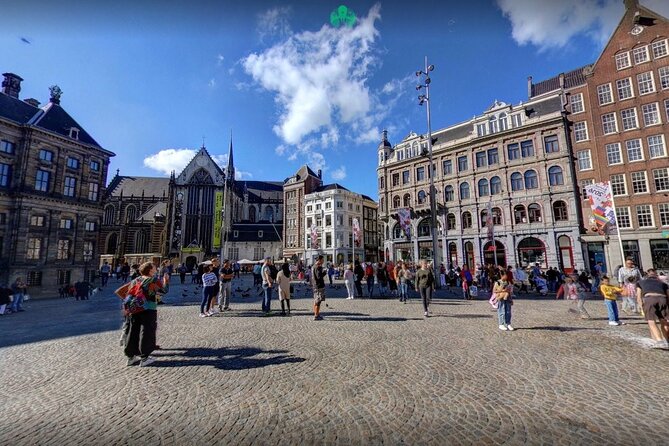
You start at Dam SquareDam, 1012 Amsterdam and finish at Belle (Sex Worker Commemorative Statue), Oudekerksplein 19, 1012 GX Amsterdam.
This isn’t a half-day project. Expect about 35 minutes, depending on how often you pause for the story, photos, or simply to process what you’re hearing.
The tour operates daily, with opening hours listed as 12:00 AM–11:59 PM for the stated date range. Translation: you can fit it into almost any time in your day. If you prefer a calmer street, you’ll probably do better earlier rather than late-night.
Stop-by-stop: what you’ll learn as you walk
Below is the core route logic: you’re led through key landmarks and themes—sea defenses, city squares, public art, and church history—so you end at the Belle statue with more context than when you started.
You can also read our reviews of more tours and experiences in Amsterdam





Dam Square: the neighborhood behind the noise
Your first segment asks you to look past the obvious tourist chaos. It frames the Red Light District as a living neighborhood, with Dutch roots in tolerance and pragmatism.
This opening matters. If you start the walk already annoyed or amused in the wrong way, the rest of the audio can feel like it’s trying too hard. But if you start curious, the tone sets up what comes next: Amsterdam didn’t build this area out of nowhere. It grew the city around water, trade, and changing social reality.
The tour also makes it clear you’ll hear sexual-themed content. The good news is that the narration is meant to inform, not to shock.
Zeedijk: a sea-dike built around survival
Next up is Zeedijk, the old “sea-dike.” The audio points out that it was likely built around the 1100s to protect early Amsterdam from the tides and flooding risk.
This is a clever pivot. Even though you’re walking in a modern entertainment zone, the story keeps reminding you that the city itself was once defined by water management. Amsterdam’s tolerance and pragmatism didn’t appear by accident. They were practical responses to real pressure—like the sea.
If you like city history that connects the physical place to the big forces that shaped it, this stop does that.
Nieuwmarkt Square: seasonal variety and the modern hangout effect
Then you reach Nieuwmarkt Square, described in a way that feels real: depending on the time of year, the square might be empty, or you might catch a market, or even a carnival setup.
The narration also calls out Nieuwmarkt as a hotspot for today’s hipster crowd. That’s not just a throwaway line. It helps you understand how the Red Light District sits inside the broader Amsterdam vibe: you’re not in a sealed-off museum. You’re in a city where different “modes” overlap on the same map.
If you’re there at a busy moment, you might have to work a little harder to hear the audio. If you’re there at a quieter time, the story will land more clearly.
Belle statue: Els Rijerse’s public-art statement
One of the most meaningful stops is the Belle statue. The tour credits Dutch artist Else Rijerse, created by request of Mariska Majoor, the founder of the Prostitutes Information Center. The stated aim is to encourage respect.
This is the kind of stop you’ll remember long after you leave the street. It turns the area from a stereotype into an ongoing conversation—about dignity, information, and public visibility.
If you’ve ever wondered why Amsterdam talks about this subject so openly compared with many places, public art is one answer. This statue is designed to put the topic in daylight, framed by respect rather than rumor.
De Oude Kerk area: layers of church history near the end
As you finish toward the Belle end-point, the audio also covers the history of de Oude Kerk. It explains that the first wooden church at the site dates to the 1200s, and it was replaced in 1306 by a brick structure.
The narration notes that the main hall remains from later building phases, while other parts were added over the centuries. In other words: even here, the city shows you layers—old structures changing over time, not vanishing when the city modernizes.
This stop gives your brain a breather. After sexual-themed context and public-art symbolism, the shift to medieval-to-modern building history helps you re-center on how Amsterdam keeps evolving.
How good is the audio and directions in real walking terms?
From the way people describe the experience, the biggest win is the clarity of the audio. You get walking directions with visual cues, and the audio starts automatically at each stop when your GPS location lines up.
That’s a rare combo. Many audio tours either:
- give good storytelling but weak navigation, or
- give good navigation but dry content.
Here, the directions are a major part of the value. One person specifically pointed out that it was easy to use with the phone in your pocket because GPS ties the narration to your movement.
Another praised the fact that the tour can be paused and replayed. That’s important if you’re standing where the street gets loud, or if you just want to hear the part about Belle again before moving on.
Value check: what $9.99 gets you (and what it doesn’t)
At $9.99 per person, you’re paying for a focused, self-paced walk—not for transport, food, or museum admissions.
Included features that add real value:
- Lifetime access to the audio tour
- The VoiceMap app
- Offline access to audio, maps, and geodata
Not included:
- A smartphone
- Transportation
- Food and drink
- Tickets or entrance fees to any museums or attractions on the route
So this is a budget-friendly option if you want to understand the area while keeping costs low. It’s also good for short attention spans: 35 minutes is enough to learn a handful of meaningful things without feeling like you’ve signed up for a long production.
The one tradeoff is that you don’t get to roam at random. The route is set, and the stops are the stops. If you expect a wide menu of sights, this may feel like it moves you along too quickly.
Who should book this self-guided Red Light District audio tour?
This works best for you if:
- you want to explore at your own pace
- you’d rather avoid live tours in the area
- you like walking with a story, but still want freedom to stop and look
- you’re comfortable using a phone for navigation and audio
It also fits first-timers to self-guided tours. One review-style takeaway: downloading is straightforward, the interface is friendly, and the GPS linkage helps you feel oriented rather than lost.
If you’re traveling with someone who has different interests, the self-guided format is handy. You can linger at a stop without holding the whole group back.
When you might feel a little underwhelmed
A self-guided tour is honest by nature. It shows you what it includes, and it doesn’t promise a bigger set of surprises.
If you go in expecting a broader sweep of landmarks beyond the named stops, you might finish thinking you wanted more variety. That’s not a flaw in the tour so much as a mismatch in expectations.
Also, because you’re in a lively part of town, street sound can affect your listening. Offline mode helps, but it can’t control foot traffic, chatter, or the general noise of the area.
Should you book it? My practical take
Book it if you want a short, respectful, well-navigated way to understand what you’re seeing. The audio clarity, GPS-triggered segments, and offline setup make it a solid value for the price. Add in the focused stops like Belle and the nearby de Oude Kerk context, and you’ll leave with more than just photos.
Skip it if you want a long, roaming tour with lots of unplanned detours. This is a defined walk with defined stories. If that sounds perfect, you’re in the right place.
FAQ
FAQ
How long is the Amsterdam Red Light District audio tour?
It’s about 35 minutes, approximately.
Where does the tour start and end?
It starts at Dam SquareDam, 1012 Amsterdam, and ends at Belle (Sex Worker Commemorative Statue), Oudekerksplein 19, 1012 GX Amsterdam.
What language is the audio available in?
The tour is offered in English.
Does the audio tour work offline?
Yes. The tour includes offline access to audio, maps, and geodata.
Do I need to bring a smartphone?
Yes. A smartphone is not included.
What’s included in the price?
You get lifetime access to the Amsterdam Red Light District tour, plus the VoiceMap application and offline access to audio, maps, and geodata.
Is transportation or food included?
No. Transportation and food/drink are not included.
Are there any tickets or museum entries included?
No. Tickets or entrance fees to museums or other attractions are not included.
Is the tour compliant with regulations for the Red Light District?
Yes. It is fully compliant with regulations that bar Red Light District tours, so it’s self-guided rather than a live guided tour.
Can I cancel and get a refund?
No. The experience is non-refundable and cannot be changed for any reason.
Are service animals allowed?
Yes. Service animals are allowed.