REVIEW · AMSTERDAM
Anne Frank Small Group Walking Tour
Book on Viator →Operated by Tours of Amsterdam · Bookable on Viator
Anne Frank’s Amsterdam has hard edges. This Anne Frank Small Group Walking Tour links major WWII landmarks with story-led explanations that make the past feel close to what you’re standing on. I like the structure too: about 20 minutes per stop, and guides like Stefan who keep the facts clear and the questions thoughtful.
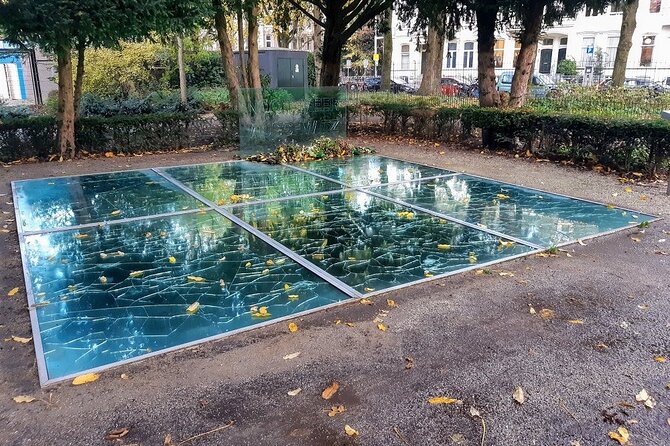
The second thing I like is the mix of places, from sacred spaces to public memorial design, including the broken-mirror Auschwitz installation in Wertheimpark. One drawback: the tour is mainly outside key buildings, and it does not include entry to the Anne Frank House, so you’ll need separate tickets if you want to go inside.
Key highlights you’ll care about
- A 2-hour route with six meaningful stops, paced at roughly 20 minutes each
- Wertheimpark’s broken mirrors at the Auschwitz Memorial, designed to symbolize shattered lives
- National Holocaust Memorial by Daniel Libeskind in a still-developing stage you can visit now
- Portuguese Synagogue start point tied to Amsterdam’s Jewish heritage and architectural history
- Zuiderkerk (Southern Church) for religion, city change, and a tower viewpoint
- Ends near the Anne Frank House, but with tickets for entry handled separately
In This Review
- Walking the Anne Frank story through Amsterdam’s most important WWII landmarks
- Meeting at Jonas Daniël Meijerplein and ending by Westermarkt: plan your timing
- Portuguese Synagogue: start with Jewish history and wooden vaults (from outside)
- The National Holocaust Memorial by Daniel Libeskind: a site you can visit while it’s still taking shape
- Wertheimpark’s Auschwitz Memorial: broken mirrors and sky reflections
- Rembrandt House Museum area: how art and daily life shaped the city
- Zuiderkerk (Southern Church): Amsterdam’s first Protestant church and a tower viewpoint
- The Anne Frank Statue: a closing moment near the house, with tickets still separate
- Price and value: why $37 makes sense for a historian-led WWII route
- What it feels like in practice: pacing, group size, and how to get the most
- Who should book this Anne Frank walking tour?
- Should you book it?
- FAQ
- Where does the tour start?
- Where does the tour end?
- How long is the Anne Frank Small Group Walking Tour?
- How much does the tour cost?
- Is the ticket mobile?
- Does the tour include entry to the Anne Frank House?
- Do I need admission tickets for the Portuguese Synagogue, Rembrandt House, or Zuiderkerk?
- Will I be able to see the National Holocaust Memorial if it is still under development?
- Are service animals allowed, and is the tour suitable for most people?
- What is the cancellation deadline for a full refund?
Walking the Anne Frank story through Amsterdam’s most important WWII landmarks

If you want Amsterdam with meaning, this is a smart way to do it. Instead of bouncing between random spots, the walk strings together places that connect Jewish life, Nazi occupation, and Dutch remembrance—so the story builds step by step as you move through the city.
The best part for your time budget is how the tour is organized. You’re typically out for about two hours, with a tight route and enough stop time to actually look, listen, and absorb. It also helps that the guide is an expert historian, since you’re not just hearing names and dates—you’re getting context for why each site matters.
This is also a good tour if you want a “starter pack” for Amsterdam’s WWII-era locations without trying to plan them all yourself. The route starts at the Portuguese Synagogue area, then moves through memorials and museum-linked stops, and finishes near the Anne Frank House.
One practical note: the day’s visit includes several stops where you don’t go inside paid spaces. That’s not a deal-breaker, but it does shape your expectations—especially if the Anne Frank House is your top must-do.
Meeting at Jonas Daniël Meijerplein and ending by Westermarkt: plan your timing
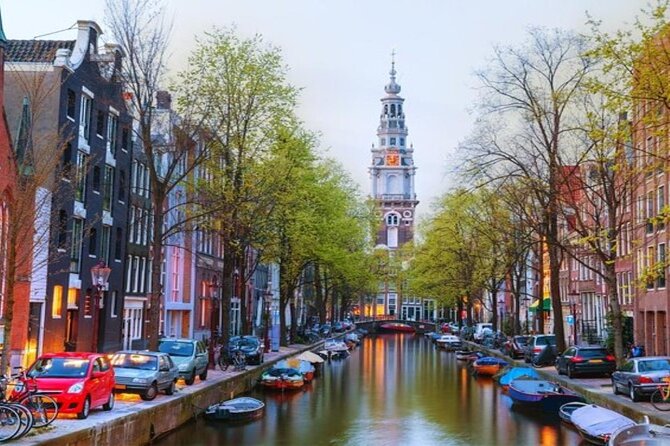
The tour meets at Jonas Daniël Meijerplein 21, 1011 RG Amsterdam, and it typically starts at 1:00 pm. That’s a helpful anchor point because you can map your arrival to a single address and keep the rest of the day from turning into guesswork.
You’ll finish close to the Anne Frank House, with the ending point listed near Westermarkt 20, 1016 GV Amsterdam. If you want to visit the house afterward, treat this tour as your warm-up. The walk ends near the area, but entry to the Anne Frank House is not included, so you’ll need tickets separately if you decide to go in.
The tour runs with a maximum group size of up to 140 people. That’s not tiny, but it’s still a manageable walking group size for a city route of this length—especially since the structure keeps you moving and listening at planned stops. The experience also uses a mobile ticket, which usually makes check-in easier than printed vouchers.
You can also read our reviews of more walking tours in Amsterdam



Portuguese Synagogue: start with Jewish history and wooden vaults (from outside)
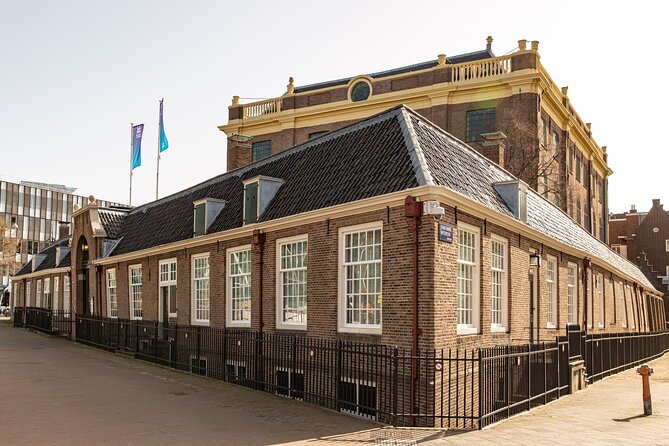
You begin at the Portuguese Synagogue, a 17th-century Sephardic synagogue known for its vast interior and the look of its wooden vaulted ceilings. The details that stand out here aren’t just architectural trivia. They connect Amsterdam’s Jewish community to a place that’s worth understanding on its own terms before the WWII story begins.
There’s also an authenticity factor mentioned for this site: it’s preserved in a way that avoids modern lights and heating to maintain its original character. That matters because memorial tours can sometimes feel like you’re only rushing toward the darkest part of history. Starting at a place of cultural and religious life reminds you what was lost, not just what happened later.
One watch-out: the tour does not include admission for the synagogue, and it’s conducted outside rather than as an inside visit. So if you’re expecting an interior tour of the sanctuary, you’ll want to adjust your plan and keep your focus on the storytelling and the exterior context.
For many people, this first stop sets the emotional tone. You’re not thrown immediately into memorial design. You’re given a foundation: who lived here, what spaces mattered, and why those details are part of the larger WWII narrative.
The National Holocaust Memorial by Daniel Libeskind: a site you can visit while it’s still taking shape
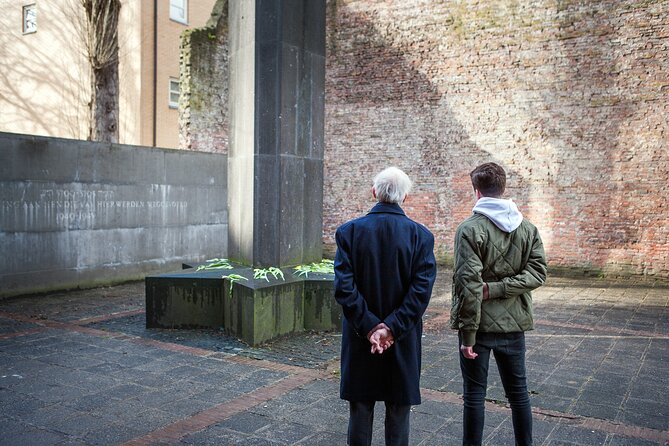
Next comes the National Holocaust Memorial, designed by Daniel Libeskind. A key point here is that the memorial is still under development, with completion expected in the future. That means your visit is a snapshot of the site in its current state, not the final finished installation.
Even so, this stop can be powerful because it highlights something important: remembrance is not always a static object. It’s often a process—plans evolve, designs change, and cities work for years to get the form right.
The practical benefit for you is pacing. This memorial stop is free, and it’s timed so you can take in what’s there without feeling rushed. You’ll have a brief window—about 20 minutes—to look, listen, and let the guide connect the architecture to Dutch victims’ history.
Because it’s under construction, it’s also smart to keep your expectations flexible. You’re not checking off a completed museum-style exhibit. You’re seeing an evolving public memory project, and that difference is part of what you’re absorbing.
Wertheimpark’s Auschwitz Memorial: broken mirrors and sky reflections
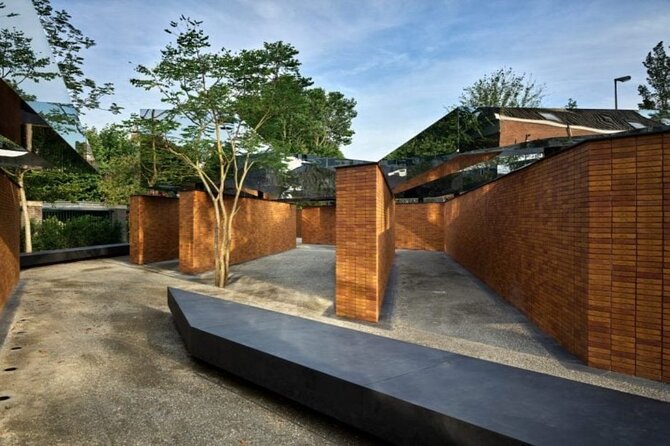
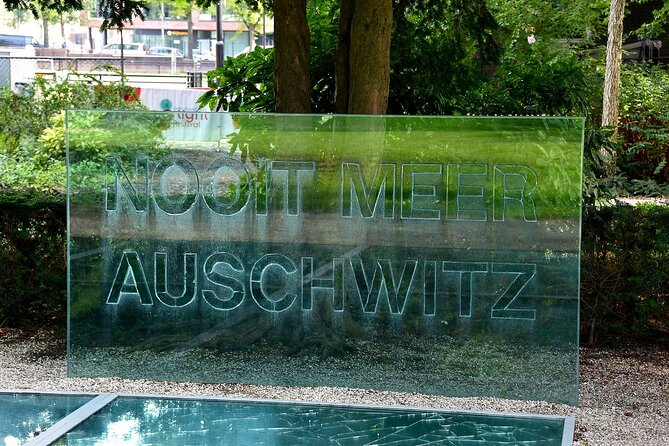
Then you move to the Auschwitz Memorial in Wertheimpark, created by Jan Wolkers. This is one of the stops that tends to hit hardest, and there’s a clear design idea behind it: broken mirrors that reflect the sky in fragments.
That visual concept does more than look symbolic. It forces a kind of attention. You can’t really look away from the fractured reflections because they keep showing up in your peripheral vision as you walk and stand. It’s the sort of design that makes the space feel “alive” with meaning rather than just decorative.
This stop is also free, and like the others, it’s scheduled for around 20 minutes. That duration is enough to feel the emotional weight without turning it into a staring contest. You’ll want to use the time deliberately: stand for a moment, look around, and let the guide connect what you’re seeing to what it represents.
If you’re sensitive to heavy themes, this is the place to slow down mentally. It’s not graphic in the way some exhibits can be, but the message is blunt. You’ll be in open air, surrounded by city movement, which can make the symbolism feel even more jarring.
Rembrandt House Museum area: how art and daily life shaped the city
After the memorials, the tour pivots to a different kind of history at the Rembrandts Amsterdam Experience / Rembrandt House Museum. Rembrandt’s life and work are tied to this location, and the site is described as restored to its original state—meant to reflect his world rather than just act as a display box.
What’s useful for you is that this stop doesn’t feel random. It’s about showing Amsterdam as a living place—people, trades, studios, and craft—so the WWII story doesn’t swallow the entire city. You’re also given cues about what the museum focuses on: Rembrandt’s etchings, personal items, and painting techniques.
Just like the synagogue stop, admission isn’t included, and the tour is conducted outside rather than as a ticketed interior visit. So your experience here is more about the connection and interpretation than about roaming galleries.
Still, I like this placement in the route. After heavy remembrance, the walk gives your brain a breather without skipping meaning. You shift from memorial symbolism to human creativity—then you keep walking toward the religious and personal-history landmarks that close the story.






Zuiderkerk (Southern Church): Amsterdam’s first Protestant church and a tower viewpoint
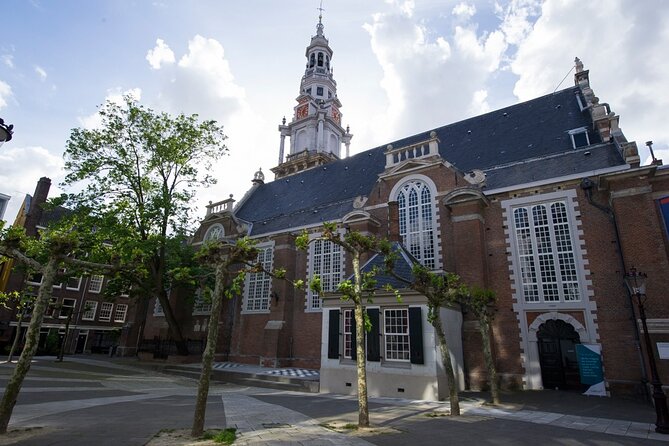
Next is the Zuiderkerk, Amsterdam’s first Protestant church, often called the Southern Church. This stop makes a different kind of historical point: Amsterdam’s religious and civic shifts over time.
The church is now used as a municipal information center, but it’s still significant for its architecture—especially the tower, which offers city views. The tour experience here is about looking at the building and understanding its role in the city’s evolution, not about buying an entry ticket.
If you’re the type who likes practical payoffs, this stop is a good one. Even if you don’t go inside, the tower and location help you get a sense of how Amsterdam’s skyline and neighborhoods developed. You also get a better sense of the city as more than a backdrop for WWII.
One more reason this stop works well on a walking route: the tone changes. You’re moving from memorial design and personal story toward place-based city history. That keeps the tour from feeling like a single emotional note.
The Anne Frank Statue: a closing moment near the house, with tickets still separate
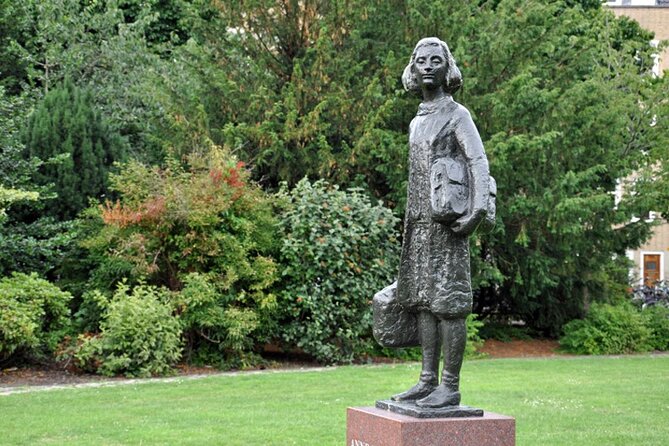
You finish at the Anne Frank Statue near the Anne Frank House. It’s a gentle but firm landing spot: a tribute that points you back to the house and the legacy that followed Anne’s story.
But here’s the key planning detail. This tour does not include entry to the Anne Frank House. You’ll end nearby, close enough to continue immediately if you’ve already arranged tickets, but you’ll need to buy those separately if you want the inside visit.
This is also where the tour’s title and emotional purpose come together. The stop isn’t just about Anne Frank as a name. It’s about the consequences of intolerance and the long shadow of persecution—made concrete by ending right where Anne’s story is anchored in Amsterdam.
If your time in Amsterdam is tight, this ending is practical. You can use the tour to understand the broader context, then decide how much time you want to spend at the Anne Frank House itself afterward.
Price and value: why $37 makes sense for a historian-led WWII route
The price is $37, and the tour lasts about two hours. For many history-focused visitors, that’s a fair trade because you’re paying for guided interpretation by an expert historian, plus the structure that takes you through multiple major sites without having to coordinate transit or search for context.
What also helps value: several stops are free. The National Holocaust Memorial and the Auschwitz Memorial in Wertheimpark are listed as free, and the Anne Frank Statue stop is also free. Paid admissions only come into play for places like the Portuguese Synagogue and Rembrandt House Museum, plus Zuiderkerk—though you should assume the tour itself is done outside those buildings and doesn’t include entry.
So think of your money as buying the storyline and the route, not a schedule of museum ticket scans. If you later want to add an interior visit, you can do that on your terms.
One more value point: the tour uses a mobile ticket, which is usually faster on the ground and reduces the need to wrangle printed documents.
If you’re comparing this with other Amsterdam options, the big advantage is that it connects sites with meaning. Amsterdam has plenty of beautiful architecture. This tour uses that beauty as a lens for the places where human lives were affected.
What it feels like in practice: pacing, group size, and how to get the most
A tour like this works best when you give yourself a little mental space. You’re moving from one emotionally heavy idea to another, then back through city-history context, and finally into Anne Frank’s legacy.
The time plan helps. Each stop is about 20 minutes, so you’re not stuck too long at any one point. That’s good for staying present, especially around memorial art where you might feel compelled to stare.
Group size can matter with somber tours. With a maximum cap of 140, you should expect some level of crowding at outdoor stops—still, the walking route and the fixed timing help keep you from feeling lost.
The guide’s job in this kind of itinerary is crucial: they’re the translator between what you see and what it means. Guides like Stefan are highlighted for explaining facts in depth and asking thought-provoking questions, which tends to make the stops feel less like photo opportunities and more like comprehension.
If you want to get extra value, I suggest you bring a notepad or use your phone notes after the tour. Write down one thing you learned at each stop while it’s fresh. Memorable memorial tours often fade fast once you move on to other parts of the city.
Who should book this Anne Frank walking tour?
This tour fits well if you:
- want a guided route through several key WWII and remembrance sites in Amsterdam
- prefer an outdoor walking format with time to look and listen
- like having a historian connect architecture and personal story
- want a practical way to understand the Anne Frank House area without committing to the interior visit in advance
It may not fit as well if you:
- strongly want to go inside the Portuguese Synagogue, Rembrandt House Museum, or Zuiderkerk as part of the tour
- want immediate Anne Frank House entry included, since tickets are not part of this experience
Should you book it?
Yes, you should book this tour if you want a clear, guided storyline across Amsterdam’s most important WWII-era places—and you’re okay with the format being mostly outside and focused on interpretation. The $37 price is reasonable for a historian-led walk that hits multiple high-impact stops, including free memorials, plus an ending right by the Anne Frank House.
If the Anne Frank House is non-negotiable for you, plan ahead so you can add it afterward with separate tickets. Treat this tour as the context that makes that inside visit mean more.
FAQ
Where does the tour start?
The tour meets at Jonas Daniël Meijerplein 21, 1011 RG Amsterdam, Netherlands.
Where does the tour end?
The tour ends near the Anne Frank House, at Westermarkt 20, 1016 GV Amsterdam.
How long is the Anne Frank Small Group Walking Tour?
It runs for about 2 hours (approx.), with around 20 minutes at each stop.
How much does the tour cost?
The price is $37.
Is the ticket mobile?
Yes, the tour includes a mobile ticket.
Does the tour include entry to the Anne Frank House?
No. The tour does not include entry to the Anne Frank House, even though it ends nearby.
Do I need admission tickets for the Portuguese Synagogue, Rembrandt House, or Zuiderkerk?
Admissions are not included for those stops. The tour is conducted outside those buildings.
Will I be able to see the National Holocaust Memorial if it is still under development?
Yes. The tour includes a stop at the National Holocaust Memorial, even though it is described as still under development.
Are service animals allowed, and is the tour suitable for most people?
Yes. Service animals are allowed, and most travelers can participate.
What is the cancellation deadline for a full refund?
You can cancel for a full refund up to 24 hours in advance of the experience’s start time.