REVIEW · AMSTERDAM
Walking Tour about Golden Age Architecture, private local guide
Book on Viator →Operated by Artsy Tours · Bookable on Viator
You can read Amsterdam’s 17th century buildings like a story. This private Golden Age architecture walking tour strings key sights together with design-and-engineering explanations you’ll miss on your own.
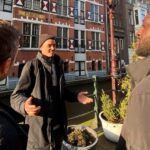
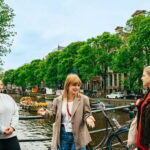
I especially like how the tour turns landmarks into context—why they were built, who paid for them, and what that meant for daily life. It also feels worth the money because you get a real one-on-one local guide named Anna, with time to ask questions and take photos.
One consideration: it’s a 1.5-hour walk and it’s not recommended if you use a walker or have trouble standing and walking for that long. Also, there’s no mobility help provided, so plan accordingly.
In This Review
- Golden Age Architecture: The Main Point of This Private Walk
- Why This 90-Minute Golden Age Route Works
- Getting Your Bearings at Dam Square
- Royal Palace Amsterdam: Neoclassical Style, Built on Hard Ground
- Huis Bartolotti: Red Brick, Baroque Detail, and Trade Connections
- Torensluis Bridge: Four Mercantile Faces and the Fun of Crooked Houses
- De Dolphijn: A Dolphin as a Wealth Signal
- Ronde Lutherse Kerk: Why Domes Mattered in the Renaissance Era
- Prinsengracht Warehouses: Practical Trade Design You Can Actually See
- Jordaan Facade Stones: How to Read the City Like a Local
- Westerkerk: The Spire, the Crown, and Rembrandt’s Last Place
- Price and Value: What $73.59 Gets You
- Who This Tour Suits Best (and Who Should Rethink It)
- Should You Book This Golden Age Architecture Walking Tour?
- FAQ
- How long is the walking tour?
- Is the tour private?
- What language is the tour offered in?
- Where does the tour start and end?
- Are admission tickets included?
- What is included in the price?
- Is bottled water included?
- Is it suitable for people who use a walker or have mobility challenges?
- What’s the cancellation policy?
Golden Age Architecture: The Main Point of This Private Walk
- Private, local guide (Anna) who connects buildings to the people behind them
- 90 minutes to cover big-picture highlights of Amsterdam’s canal-belt architecture
- Design and engineering stories beyond what you’ll usually get on casual street walks
- Canal-belt facades you learn to notice: sandstone details, facade stones, hoisting beams
- Multiple “style moments” in one route: neoclassical, Dutch baroque, mercantile-era practical design
- Ends near Westerkerk, so it’s easy to roll into the Anne Frank House area afterward
Why This 90-Minute Golden Age Route Works
Amsterdam can feel like a lot of looking and not much understanding. This tour fixes that by focusing on architecture as evidence—what materials, shapes, and details reveal about wealth, trade, and even construction challenges.
The other smart move is pacing. You’re not trying to see everything in the city; you’re seeing a sequence that explains how Amsterdam’s prosperity shaped what people built and how they built it. For most visitors, that’s the fastest path to a real sense of place.
And because it’s private, you don’t lose time to a crowded group. You can ask follow-ups when something catches your eye, including the small carvings and façade clues that are otherwise easy to overlook.
You can also read our reviews of more walking tours in Amsterdam



Getting Your Bearings at Dam Square
The tour starts at the Royal Palace area, and the first stop is Dam Square. You’ll get a clear starting point for Amsterdam’s rise in the 17th century, when the city became a global trade hub and its architecture started reflecting that power.
Dam Square is more than a “meet here” landmark. It’s a place where big civic ambition shows up, and the guide uses it to frame what you’ll see next: a city built by merchants, financed by commerce, and shaped by constant building pressure.
If you’re the kind of traveler who likes to understand what you’re looking at before you stare for an hour, this opening helps a lot.
Royal Palace Amsterdam: Neoclassical Style, Built on Hard Ground
Next comes Royal Palace Amsterdam, originally built as the city’s town hall in the Dutch Golden Age. You’ll hear how it signaled Amsterdam’s prosperity, then later shifted into its royal role.
What I like most here is the mix of aesthetics and engineering. You’ll look at the Dutch neoclassical style, then learn about the practical reality underneath: construction on challenging clay and marshy ground. Amsterdam’s soft terrain is a constant theme, and this stop makes it real instead of abstract.
Think of it this way: the palace isn’t just pretty. It’s a “we can build here anyway” message.
Huis Bartolotti: Red Brick, Baroque Detail, and Trade Connections
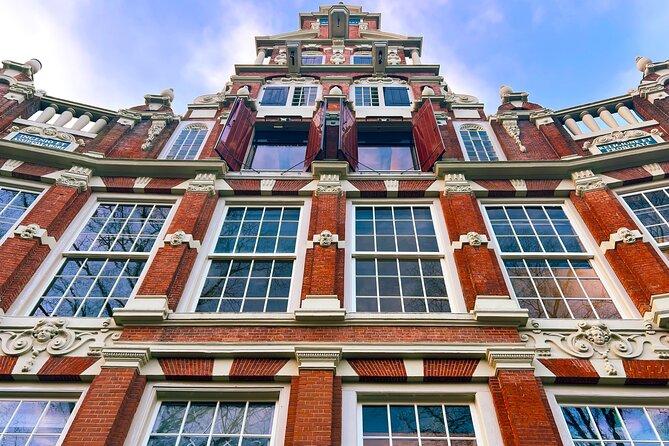
At Huis Bartolotti, you’ll get a taste of 17th-century Dutch baroque along the canal. The façade story is visual right away: striking red brick, big windows, and sculptural sandstone details.
The guide also ties the house to ownership and trade. You’ll learn that the ornate design reflected wealth and status, plus trading links with Italy. That’s a key pattern in Amsterdam: the city’s architecture looks local, but the influences and business relationships often weren’t.
If you tend to “walk past” façades, this stop helps you slow down and look for the details that signal rank and occupation.
Torensluis Bridge: Four Mercantile Faces and the Fun of Crooked Houses
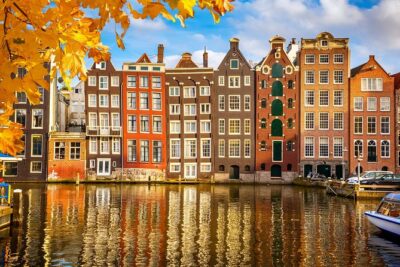
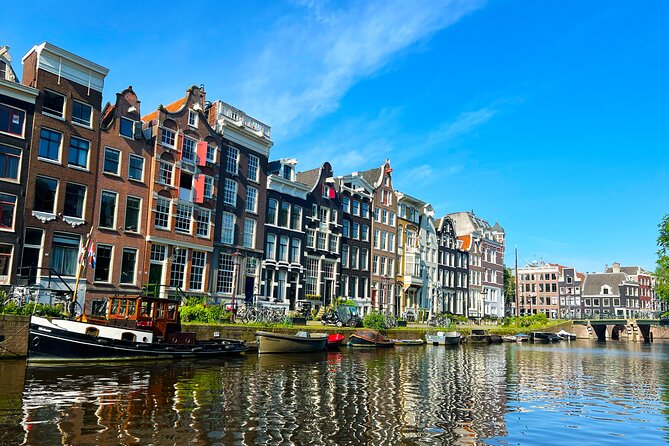
At Torensluis, you get one of those rare view moments where architecture comes in layers. The bridge gives you a direct look at four different façade designs associated with the mercantile class.
You’ll also notice how baroque style was adapted in the Netherlands—less about dramatic theater, more about refined detail. Then comes the Amsterdam twist: the crooked houses. Because the ground is soft, buildings lean in ways that can look whimsical, but the cause is practical engineering and long-term settling.
This is a great stop to reset your expectations. In Amsterdam, imperfections aren’t always neglect—they can be part of how the city physically lives.
You can also read our reviews of more guided tours in Amsterdam


De Dolphijn: A Dolphin as a Wealth Signal
Then you’ll move to De Dolphijn, where the building’s name connects to the city’s maritime prosperity. The dolphin symbol represented wealth tied to Amsterdam’s sea trade during the Golden Age.
You’ll also hear a very specific historical link: the house was owned by Frans Banning Cocq, the captain shown in Rembrandt’s famous The Night Watch. That kind of connection is why this tour feels different from a generic architecture walk—you see a façade, then you understand how it connects to art, status, and a particular era of the city.
Expect to spend a few minutes soaking in a façade that’s small compared to the big public buildings, but loaded with meaning.
Ronde Lutherse Kerk: Why Domes Mattered in the Renaissance Era
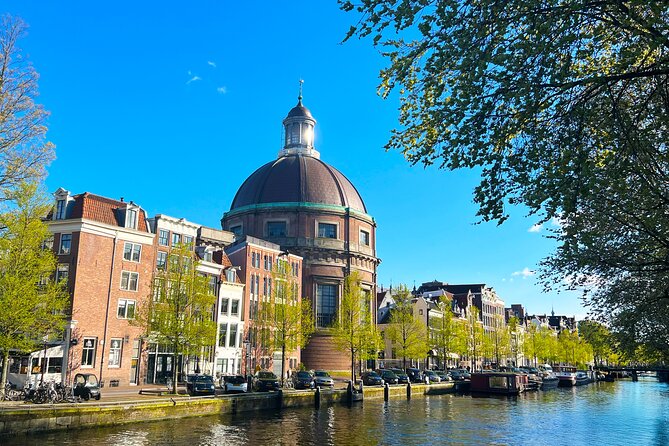
Next is Ronde Lutherse Kerk, where the focus shifts to a structural idea: domes as a high point of Renaissance architectural achievement.
The stop is brief, but it’s useful if you want more than 17th-century “canal belt sameness.” A dome changes how you read space and form, and it’s a reminder that Amsterdam’s architecture wasn’t trapped in one style period.
If you’re scanning quickly, don’t skip this: even a short stop like this can help you notice how different building shapes communicate different eras.
Prinsengracht Warehouses: Practical Trade Design You Can Actually See
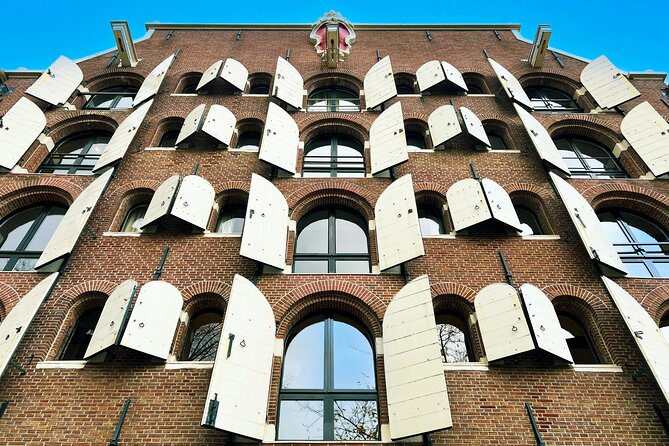
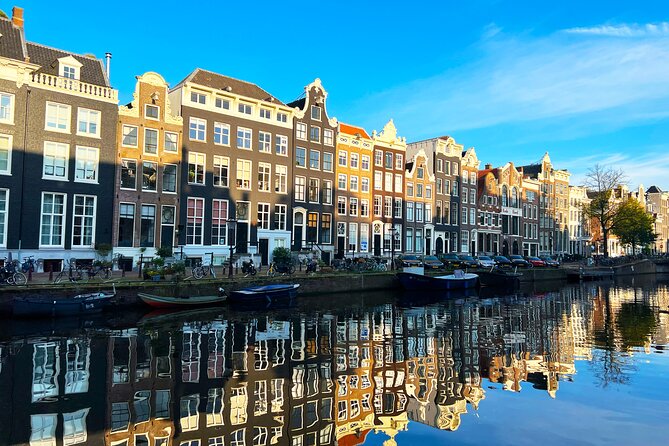
A major highlight is Prinsengracht, especially the warehouses along the canal. This is where the tour gets technical in a good way, because these buildings weren’t designed for decoration first—they were built for cargo.
You’ll learn what makes them work:
- tall, steeply pitched gables
- large windows
- wooden hoisting beams on the roof
Those beams mattered because they lifted heavy goods from ships docked along the canal. That’s engineering disguised as architecture, and it’s the kind of explanation that changes how you interpret the canal belt on your next walk.
What else stands out is the exterior logic. The buildings often look simple and functional, with minimal ornamentation. The grandness comes from scale and the strength of the merchants behind it—not from fancy decoration.
If you want to understand why Amsterdam looks the way it does from street level, this is the part that sticks.
Jordaan Facade Stones: How to Read the City Like a Local
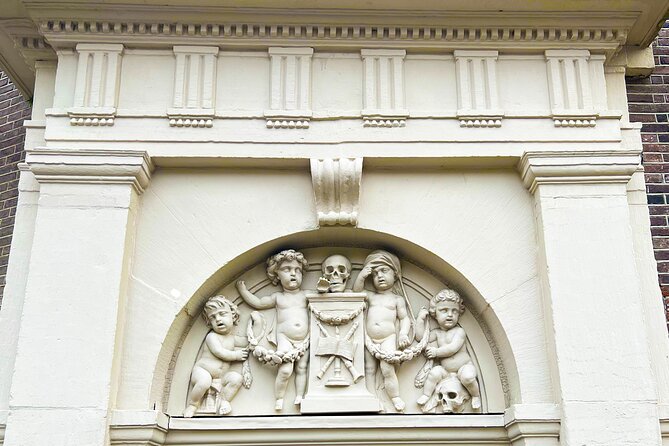
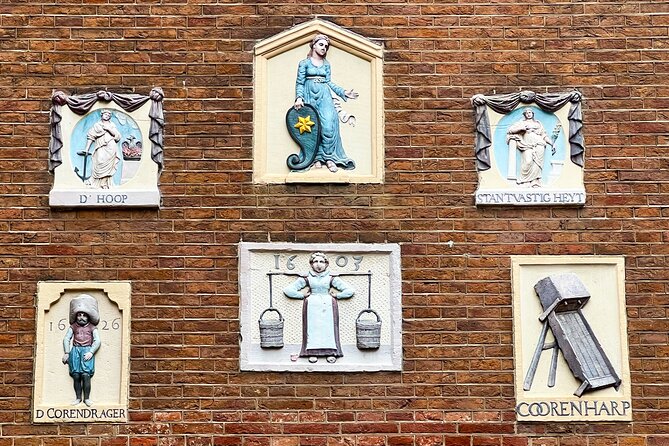
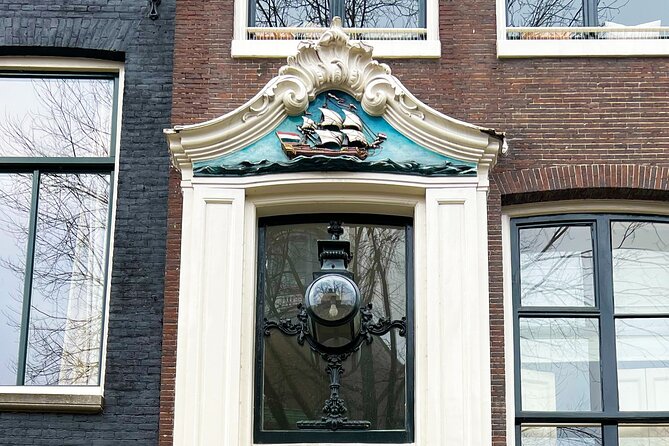
In the Jordaan, the focus shifts from big buildings to small clues: gevelstenen, or façade stones. These are decorative plaques embedded in the façades of Golden Age buildings.
Here’s the practical value. Once you learn what to look for, you start seeing stories everywhere: how the building was used, the profession of the owner, and other details about people living and working there. Many of these stones have intricate carvings, so your attention gets rewarded.
You’ll also get a sense of the neighborhood’s historical role. In the 17th century, it served as a mix of residences and businesses, developed for craftsmen and laborers before evolving into a lively area with shops and workshops at street level.
This section is especially helpful if you plan to wander after the tour. You’ll carry a “reading lens” that makes self-guided walks more satisfying.
Westerkerk: The Spire, the Crown, and Rembrandt’s Last Place
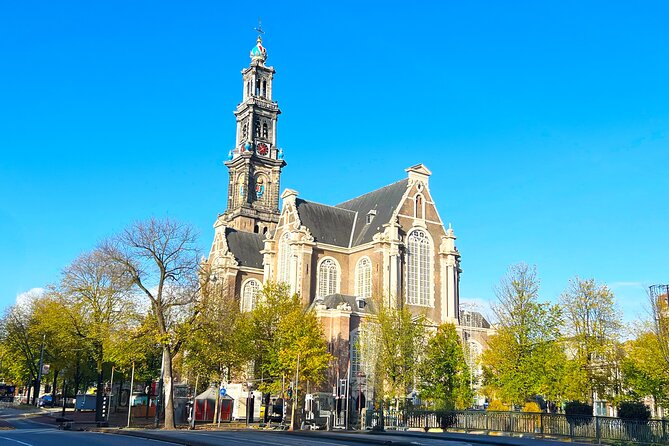
The tour finishes near Westerkerk, one of Amsterdam’s key landmarks. You’ll hear how it began as a Calvinist church for a growing population, with a simple, elegant design that fits Calvinist worship.
This stop also ties architecture to major cultural memory. Westerkerk is the final resting place of Rembrandt van Rijn, and the guide connects the church’s role to the city’s identity.
Then there’s the tower story. The spire rises about 85 meters (280 feet), completed in 1638, and crowned with an imperial crown symbolizing Amsterdam’s status. You’ll also hear about the clock and its chimes—linked to a detail described in Anne Frank’s diary—which adds a very human layer to what can otherwise feel like a purely architectural feature.
By the end, you’re not just standing next to a famous church. You’re standing at a crossroad of art, faith, and city pride.
Price and Value: What $73.59 Gets You
At $73.59 per person for about 1.5 hours, the value hinges on one thing: you’re paying for guided interpretation, not just walking between photos.
The included private guide matters here. You’re not getting a headset lecture or a quick stop-and-go “check-the-box” path. You’re getting someone like Anna who can point out architectural features you’d otherwise miss—like façade stones, building materials, and engineering decisions tied to soft ground and heavy commerce.
Also, the route uses free admission tickets for the stops listed, so you’re not likely to face surprise entry fees for major segments of the experience.
The one small catch: bottled water is not included, so bring your own if you think you’ll need it.
Who This Tour Suits Best (and Who Should Rethink It)
This is a smart choice if you:
- love architecture but want more than names and dates
- enjoy learning why buildings look the way they do
- want a fast, structured walk that still feels personal
- plan to explore Amsterdam’s canal belt afterward and want a “what am I looking at?” guide
It’s less ideal if:
- you use a walker
- you struggle with standing and walking for about 1.5 hours
- you need mobility aids (none are provided)
If you’re in good walking shape, you’ll get a lot out of the time.
Should You Book This Golden Age Architecture Walking Tour?
If your goal is to understand Amsterdam instead of just sightseeing it, I’d book this. The best part is how the tour teaches you to notice: façade stones, roof hoisting beams, baroque adaptations, and the engineering reality beneath the buildings.
I’d especially recommend it if you like hands-on learning—asking questions, slowing down for details, and getting clear explanations in English. With Anna guiding the conversation and helping you connect architectural features to the people who built them, the canal belt starts to make sense in a way that feels practical and memorable.
If you’re sensitive to walking time or mobility limits, consider alternatives that are easier on your legs. But for most visitors, this private Golden Age architecture walk is a strong use of a morning or afternoon in Amsterdam.
FAQ
How long is the walking tour?
It lasts about 1 hour 30 minutes.
Is the tour private?
Yes. It’s a private tour/activity, so only your group participates.
What language is the tour offered in?
It’s offered in English.
Where does the tour start and end?
It starts at Royal Palace Amsterdam, Nieuwezijds Voorburgwal 147, 1012 RJ Amsterdam, Netherlands. It ends near Westerkerk at Prinsengracht 279, 1016 DL Amsterdam, near the Anne Frank House area.
Are admission tickets included?
The tour information indicates admission ticket access is free for the stops.
What is included in the price?
A private guide is included.
Is bottled water included?
No, bottled water is not included.
Is it suitable for people who use a walker or have mobility challenges?
It’s not recommended for participants who use a walker or who have trouble walking and standing for 1.5 hours. Mobility aids are not available.
What’s the cancellation policy?
You can cancel for free up to 24 hours in advance for a full refund. If you cancel less than 24 hours before the start time, the amount paid is not refunded.