REVIEW · AMSTERDAM
5 hrs Golden Age Amsterdam Private Walking Tour With Local Guide
Book on Viator →Bookable on Viator
Start your Amsterdam trip with a smart plan, not stress. This private 5-hour walk is a high-impact way to get your bearings, moving through key neighborhoods and landmarks like Centraal Station, Begijnhof, De Wallen, Dam Square, and the Anne Frank House area. I especially like how the route mixes famous sights with quieter, story-rich corners, and how Aleksandar explains what you’re seeing in a way that actually sticks. One thing to factor in: several top stops have separate entry tickets (Anne Frank House, Royal Palace, Westerkerk, and others), so your final cost will depend on what you choose to enter.
In a group of up to four, you’re not just “part of a crowd.” You get real pacing freedom for photos, questions, and little detours when something catches your eye. If you want a first-day orientation that still feels personal, this is a strong fit—but if you’re hoping for a fully ticketed tour with everything included, you’ll want to plan ahead.
In This Review
- Small-Group Value: Why This Private 5-Hour Format Works
- Key Highlights You’ll Feel Right Away
- Pricing and Tickets: Where the Real Budget Goes
- Meeting Point and Timing: Plan Your Arrival for an Easy Start
- The Guide Factor: What Aleksandar’s Style Brings
- From Centraal Station to the Canal City Core
- Stop 1: Amsterdam Centraal Station
- Stop 2: St. Nicholas Basilica
- Stop 3: The Weeping Tower area
- Stop 4: Het Kleinste Huis van Amsterdam (smallest house)
- Stop 5: De Waag (Waag)
- The “Secret Amsterdam” Stops That Make the Tour Memorable
- Stop 6: Ons’ Lieve Heer op Solder (Our Lord in the Attic Museum)
- Stop 7: Fo Guang Shan (Chinatown temple)
- The De Wallen Context: See It, Understand It, Don’t Turn It Into a Theme Park
- Stop 8: Red Light District (De Wallen)
- Dam Square and Royal Power in One Stretch
- Stop 9: Dam Square
- Stop 10: Royal Palace Amsterdam (optional ticket)
- Stop 11: National Monument
- Stop 12: Nieuwe Kerk
- Begijnhof: Courtyard Calm and Medieval Faith Stories
- Stop 13: Begijnhof
- Munt Tower, Bridges, and Art That Shows Up in Monuments
- Stop 14: Munt Tower (Munttoren)
- Stop 15: Rembrandt Monument + The Night Watch detail
- Stop 15 (market segment): the flower market moment
- Stop 16: Sint Luciënsteeg and the stone-gable neighborhood feel
- Anne Frank House Area: Powerful, and Ticket-Dependent
- Stop 17: Anne Frank House (ticket not included)
- Stop 18: Westerkerk (ticket not included)
- River Amstel and the Jewish Quarter (Plantage): Another City Layer
- Stop 19: View over the Amstel
- Stop 20: Jodenbuurt (Jewish Quarter / Plantage)
- Who This Tour Is Best For (and Who Should Skip)
- Practical Tips to Get the Most Out of Your 5 Hours
- Should You Book This Private Amsterdam Walking Tour?
- FAQ
- How long is the Golden Age Amsterdam Private Walking Tour?
- What is the group size limit?
- Where do we meet for the tour?
- Are entrance fees included?
- Which paid attractions are on the route?
- Do I need to book Anne Frank House tickets in advance?
- Is pickup offered?
- What if my plans change and I need to cancel?
- Is the tour near public transportation?
Small-Group Value: Why This Private 5-Hour Format Works
This isn’t a mass-group sprint. The price is for a private group up to 4, which matters because Amsterdam’s center is busy and walking gets slower when you’re packed in. A small group keeps the tour feeling like a conversation with a local guide rather than a lecture line.
The other value play: the route is built to cover a lot of “Amsterdam you can recognize” in one morning/afternoon block, including civic sites (Royal Palace, Dam Square), religious history (St. Nicholas Basilica, Begijnhof, Nieuwe Kerk), and culture districts (Chinatown temple, the Jewish Quarter area). It’s a practical way to map the city in your head.
Key Highlights You’ll Feel Right Away
- Getting your bearings fast with a tight loop through major areas you’ll return to
- A guide who adapts how he explains things, including for kids (great for mixed families)
- Stories behind the buildings, not just photos and facts
- Time for the contrasts: canals and courtyards, plus the reality and policy context around De Wallen
- Quiet stops with payoff, like Begijnhof and the secret-church museum area
You can also read our reviews of more walking tours in Amsterdam



Pricing and Tickets: Where the Real Budget Goes
The tour price is $540.69 per group (up to 4) for about 5 hours. With four people, that works out to about $135 per person for guide time—before any entrances. If you’re traveling as a couple, your per-person cost is higher, but you still get the advantage of a small-group, private rhythm.
Here’s the practical part: many stops are listed as admission ticket free, but several major ones are not included. The tour does not bundle entry fees for these:
- Royal Palace Amsterdam: €10.00 per person
- Westerkerk: €7.00 per person
- Ons’ Lieve Heer op Solder (the attic/secret-church museum): €16.50 per person
- Anne Frank House: €16.00 per person
- Nieuwe Kerk: €10.00 per person
- Old Center: €13.50 per person
So you should budget for the “choose-your-own-adventure” moments. If Anne Frank House is on your list, that’s the biggest planning item (details below).
Meeting Point and Timing: Plan Your Arrival for an Easy Start
You’ll meet at Amsterdam Centraal (Stationsplein, 1012 AB). The tour runs Monday from 11:00 AM to 5:00 PM, with pickup offered as an option. That meeting point is convenient because you’re already in the city’s transportation hub—useful if you’re arriving by train or juggling multiple stops that day.
Duration is listed as about 5 hours, and the pacing across stops is tight but not frantic. Expect frequent short segments (some around 5–15 minutes) plus a couple longer story-and-walk moments.
The Guide Factor: What Aleksandar’s Style Brings
One of the most praised parts of this experience is the guide himself—Aleksandar (often mentioned as Aleks/Alex). What stands out from the details you’re given is not just that he’s friendly, but that he’s practical and adjusts his approach.
I like that he doesn’t talk at you like a textbook. His style is built around answering questions and keeping the group engaged. If you’re traveling with kids, that matters a lot; he’s used to shaping his explanations so different ages stay interested. He’s also described as speaking perfect English plus Slovak and languages from the former Yugoslav republics—helpful if you prefer your questions answered clearly without guessing at wording.
Also, the tour is set up to handle real-life timing: people move at different speeds, and your guide is flexible with time and requests, which makes the experience feel smoother rather than rigid.
From Centraal Station to the Canal City Core
You can also read our reviews of more guided tours in Amsterdam


Stop 1: Amsterdam Centraal Station
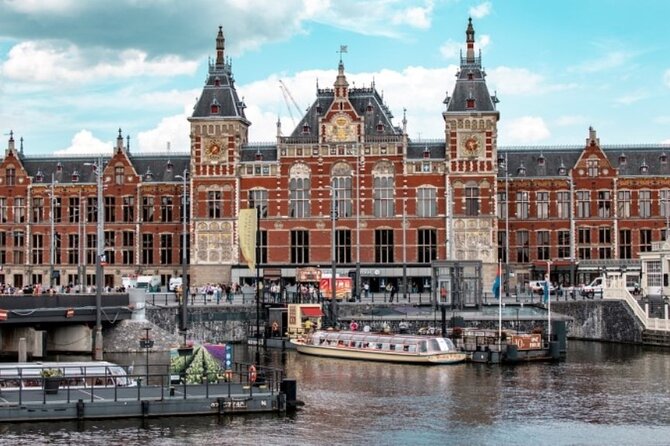
You start at Centraal Station, and it’s not a random opening photo. You’ll get the architectural context: the building reflects a Dutch neoclassical style set up in the late 19th century, built on 5,059 wooden poles. That’s a classic Amsterdam detail, and it’s the kind of fact you’ll later “see” everywhere once you start noticing how the city was engineered.
Why it’s worth it: it primes you for the wooden-pole story you’ll keep hearing across the day.
Watch-out: since this is a big, central train station, it can be crowded—arrive a few minutes early so you’re not late to the group.
Stop 2: St. Nicholas Basilica
Next is St. Nicholas Basilica, described as the biggest Catholic temple in the Netherlands, dating from the latter half of the 19th century. If you usually associate Amsterdam with Protestant-era history, this stop adds balance. You see how the city’s religious story kept changing across time.
Stop 3: The Weeping Tower area
Then you’ll reach the Weeping Tower (the former medieval wall site). You’ll also hear the dramatic link to global history: this is where Henry Hudson set sail on his journey to Northern America. It’s one of those “Amsterdam isn’t only local” moments.
Stop 4: Het Kleinste Huis van Amsterdam (smallest house)
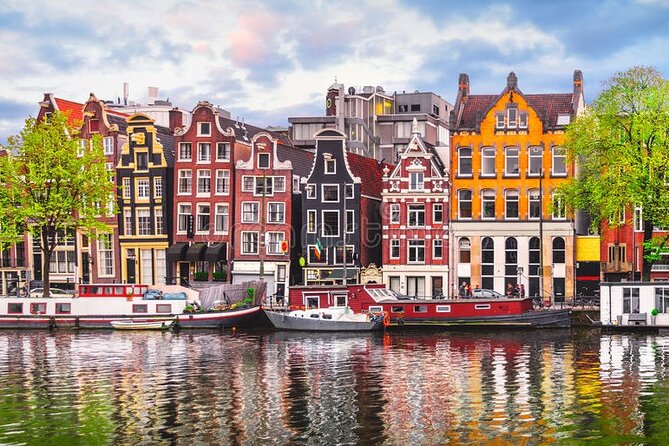
At Het Kleinste Huis van Amsterdam on the canal Singel, you’ll learn about the smallest house and the meaning of grachten (the canals of Amsterdam)—including why canals were made, what they do, and how they get maintained. You’ll also get bridge and building trivia tied to narrow, tall, and even leaning houses.
Why you’ll like it: this is Amsterdam’s physical logic in miniature. Canals, infrastructure, odd-scale architecture—all of it connects.
Stop 5: De Waag (Waag)
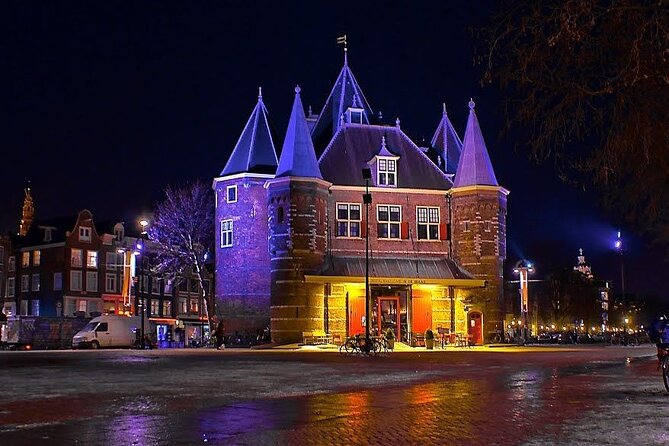
De Waag is the city’s “weigh-building,” originally a customs house and guild headquarters, dating to the early 15th century. It also once functioned as one of the gates into the inner part of the city. If you like cities that show trade and everyday power structures in stone, this is a strong stop.
The “Secret Amsterdam” Stops That Make the Tour Memorable
Stop 6: Ons’ Lieve Heer op Solder (Our Lord in the Attic Museum)
This is Amsterdam’s famous “secret church” story. You’ll cover what makes it the most known secret church concept in the city, and how it’s restored as a museum today. Admission is not included, but the tour gives you context so you’ll understand what you’re walking into if you buy tickets.
Stop 7: Fo Guang Shan (Chinatown temple)
Next comes Fo Guang Shan, a Buddhist (Chinese) traditional temple in Amsterdam’s Chinatown. It’s described as the second biggest of its kind in Europe, and you get a quick window into how Amsterdam’s religious landscape includes communities beyond the historic European categories.
The De Wallen Context: See It, Understand It, Don’t Turn It Into a Theme Park
Stop 8: Red Light District (De Wallen)
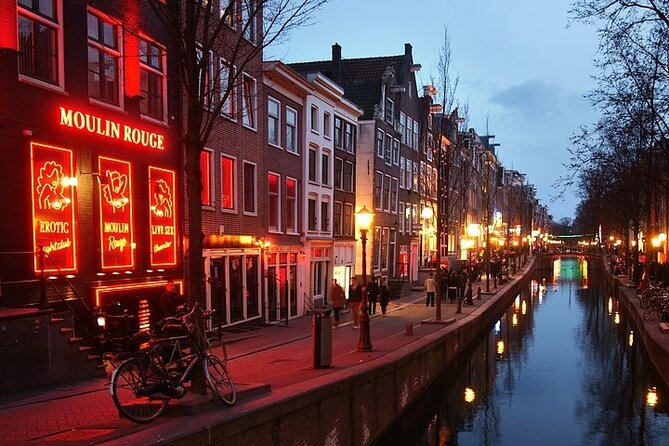
This is one of the most sensitive stops, and it’s also one of the most useful ones because the tour doesn’t treat it like only a spectacle. You’ll get a short break from walking, about 30 minutes, focused on the history of prostitution and the Dutch approach to drugs policy. You’ll also hear the “yes and no” framing around light drugs, plus friendly recommendations for how to enjoy the area while not breaking the law.
Why this stop is valuable: knowing the context changes your whole experience. You’re not just looking—you’re understanding what policies and history shaped what you see today.
Consideration: if you prefer to avoid this topic entirely, plan your day with expectations, because this part is included in the route.
Dam Square and Royal Power in One Stretch
Stop 9: Dam Square
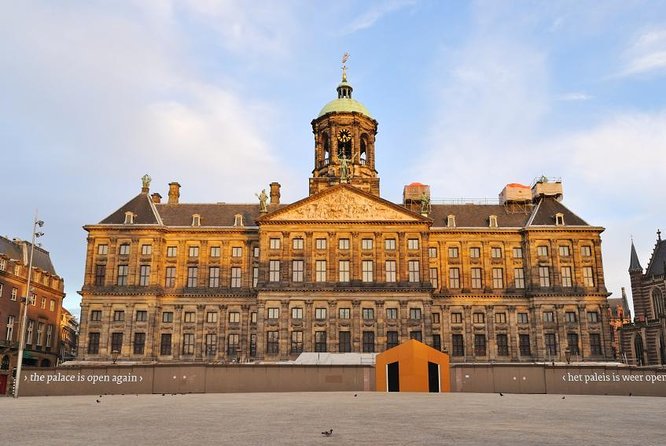
Dam Square is Amsterdam’s central square and described as the oldest, tied to the city’s birth. You’ll focus on the buildings around it, including the Royal Palace, the New Church, the National Monument, and nearby major landmarks.
Stop 10: Royal Palace Amsterdam (optional ticket)
You’ll then reach the Royal Palace Amsterdam, a former City Hall from the mid-17th century and one of the official residences of the Dutch Royal Family. It’s built on 13,659 wooden poles, which is a big “how did they do that?” moment. Entrance is not included at €10.00.
Practical note: if you’re not interested in interior rooms, you can still get a lot from the exterior and the framing.
Stop 11: National Monument
The National Monument commemorates casualties of World War II and subsequent armed conflicts. It’s described as 22 meters high, from 1956. This is a quiet, respectful pause in a visually loud city.
Stop 12: Nieuwe Kerk
Nieuwe Kerk has an origin in the 15th century and served as a worship church for the Dutch Reformed Church, still used for royal wedding/crowning ceremonies. Entrance is not included (listed at €10.00).
Begijnhof: Courtyard Calm and Medieval Faith Stories
Stop 13: Begijnhof
This is one of those “wait, this is here?” places. Begijnhof is described as a hidden memorial area dedicated to the Beguines, a semi-closed order similar to nuns, with another secret Catholic church. You’ll also hear about the oldest wooden house in Amsterdam, the English Church, and legends involving Cornelia Arens and the Miracle of Amsterdam in 1345.
You’ll love this stop if you enjoy places where the city slows down and the stone looks older than the crowds.
Consideration: it’s a courtyard setting. If the weather is rough, you might still get value, but your comfort level will depend on your tolerance for indoor/outdoor transitions.
Munt Tower, Bridges, and Art That Shows Up in Monuments
Stop 14: Munt Tower (Munttoren)
At Munttoren, you’ll learn it was originally built in the 15th century at the meeting point of the river Amstel and the canal Singel—one of the oldest canals. It served as a medieval gate and was also a place where coins were minted in the 17th century.
Stop 15: Rembrandt Monument + The Night Watch detail
The Rembrandt Monument honors Rembrandt van Rijn. You’ll also get an explanation tied to The Night Watch and even a 3D exposure described for the masterpiece. Expect trivia that connects the painting to Rembrandt’s personal life.
Stop 15 (market segment): the flower market moment
After the art stop, the route includes the biggest and most famous flower and garden accessories market in the city. It’s an excellent chance to see tulip bulb variety and other flower-related items. It’s practical too: you can spot souvenirs that are actually Amsterdam-specific.
Stop 16: Sint Luciënsteeg and the stone-gable neighborhood feel
At Sint Luciënsteeg, you’ll find the City Orphanage (Burgerweeshuis) from 1580, plus a street of stone gables and stone tablets referencing house identities through medieval ages.
This stop is more about atmosphere than one building. If you like reading architecture like a story, it’s a good use of time.
Anne Frank House Area: Powerful, and Ticket-Dependent
Stop 17: Anne Frank House (ticket not included)
You’ll visit the Anne Frank House area and learn about life in the secret shelter, suffering, human solidarity, and the diary of Anne Frank, including the fact it’s been translated into 57 world languages. Admission is not included.
Here’s the big planning detail you shouldn’t ignore: Anne Frank House tickets can be booked only online and at least 6 weeks in advance. If you show up without a ticket, you may miss the interior experience. For many people, that’s the difference between a great trip day and a frustrating one.
Stop 18: Westerkerk (ticket not included)
Next is Westerkerk, described as the third oldest church (after South and North) from 1631, with a leaning tower. It was intentionally built for Protestant believers, and it’s noted as the wedding place of former Dutch queen Beatrix. There’s also mention of a Rembrandt burial claim near by, though it’s described as never precisely proven. Entrance is not included (listed at €7.00).
River Amstel and the Jewish Quarter (Plantage): Another City Layer
Stop 19: View over the Amstel
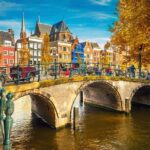
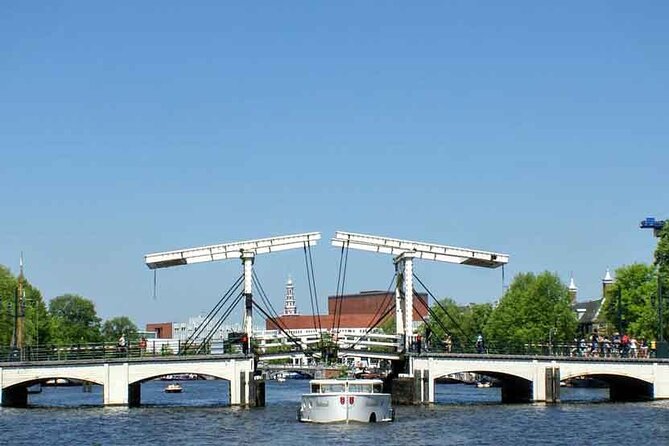
You’ll get a view of the river Amstel and surrounding buildings of higher social and cultural meaning. The route highlights some of Amsterdam’s famous bridges, including the Blue Bridge and the Skinny Bridge.
This part is a good “breather.” You’ll have walked a lot of streets by then, and looking out over the water helps the city “click” in your mind.
Stop 20: Jodenbuurt (Jewish Quarter / Plantage)
Finally, you reach Jodenbuurt, also known as Plantage, the Jewish Quarter. The description covers that from the end of the 16th century until WW2, many Jews lived in the area, and it points you toward important buildings of the community across centuries, plus Holocaust monuments and memorials.
If you like history with context and gravity, this ending lands.
Who This Tour Is Best For (and Who Should Skip)
This tour is a smart pick if:
- You want a first-time Amsterdam orientation that doesn’t just hit postcard spots
- You care about historical context—religion, trade, political power, and city planning
- You want a small group private experience for better pacing and Q&A
- You’re traveling with kids or mixed ages; the guide is described as adjusting his explanations and keeping everyone engaged
You might think twice if:
- You want a fully all-in-one ticketed day with no extra admissions
- You’d rather not include De Wallen at all; it’s part of the included route and includes policy/prostitution discussion
Practical Tips to Get the Most Out of Your 5 Hours
- Wear shoes you trust. This route is built around many short stops and lots of street-level walking.
- Decide in advance what you’re paying for. Anne Frank House and the Royal Palace/Westerkerk/Nieuwe Kerk are the big ticket items on your route.
- If Anne Frank House is a must, plan around the online ticket at least 6 weeks ahead rule.
- Bring a camera, but keep your phone ready for the “why does that exist?” moments. The canals, wooden-pole engineering, and the Begijnhof courtyard details are the kind that are easier to remember when you’ve captured them.
Should You Book This Private Amsterdam Walking Tour?
I’d book it if you want the fastest path to understanding Amsterdam as a real city, not just a checklist. The biggest wins are the small-group private feel and the way the guide connects landmarks to how Amsterdam worked—wooden poles, canal infrastructure, religious history, and the modern policies that shaped today’s streets.
If you’re the kind of traveler who likes quiet courtyards (Begijnhof), heavy historical weight (National Monument, Jewish Quarter context), and at least one “real Amsterdam” contrast stop (De Wallen) all in one day, this is a strong fit. Just treat it as a guide-led route with optional entries—not an all-inclusive admissions package—and you’ll get real value from the time.
FAQ
How long is the Golden Age Amsterdam Private Walking Tour?
It runs for about 5 hours.
What is the group size limit?
The tour has a maximum of 4 travelers.
Where do we meet for the tour?
The meeting point is Amsterdam Centraal railway station (Stationsplein, 1012 AB Amsterdam). The tour ends back at the meeting point.
Are entrance fees included?
Most stops are free, but several major attractions are not included and require separate tickets, such as Royal Palace Amsterdam, Westerkerk, Anne Frank House, Nieuwe Kerk, and Ons’ Lieve Heer op Solder.
Which paid attractions are on the route?
Royal Palace Amsterdam (€10), Westerkerk (€7), Old Center (€13.50), Anne Frank House (€16), Nieuwe Kerk (€10), and Ons’ Lieve Heer op Solder (€16.50).
Do I need to book Anne Frank House tickets in advance?
Yes. Anne Frank House tickets are available only online and at least 6 weeks in advance.
Is pickup offered?
Pickup is offered.
What if my plans change and I need to cancel?
You can cancel up to 24 hours in advance for a full refund.
Is the tour near public transportation?
Yes, it’s near public transportation, and most travelers can participate.